
Jaclyn Thurley Articles

Posts by Jaclyn Thurley

More Top Tips for Running

More Top Tips for Running

City to Surf in August…here I come!

Last month we talked about all of the posture tips for running to prevent injury and make your running style super efficient. Have any of you started to utilise at least 1 or 2 of the postural cues when running (or even walking)?

Here are a few more things to consider before you head out and start your training for the City to Surf or May SMH Half Marathon! (or to walk the dog each night).

  • Treat for your feet.

The ultimate key to success is having the right running shoes! It is always a good idea to get your shoes chosen and fitted by a qualified professional. As physiotherapists, we work closely with podiatrists and therefore get the inside intel on the leading shoe brands. Currently Brooks, New balance and Mizuno are making top-notch running shoes.

However, there are various styles in each brand, for various terrains, for various foot types. Therefore getting your shoes fitted by someone with the ‘know how’ is a must!

  • Run on the right surface

Running on the right surface can help you avoid those niggly injuries, and is especially important if you are new to running or if you are returning to running after a period of time off. The perfect terrain is level, not too soft nor too hard. Sand and grass can often be too soft, cement or road often too hard. The best by far is running on man-made dirt tracks, such as compressed gravel, stone aggregate or cinders tracks.

These ideal terrains may not be so easily on your door step, so try to mix up your surfaces to keep your body adapting and not loading up too much repetitively.

  • Don’t over-stride

Research strongly supports increasing your cadence (number of strides per minute) and shortening your stride length. This has been shown to improve your efficiency and performance, and is associated with reduced injury rates. Therefore keep your strides short, and if you want to improve your pace increase the number of strides you take per minute, rather than lengthening your stride. It is said that a cadence that is ideal for everyone running is between 80-100 steps per minute. Get counting!

  • Why not start with interval running

For both new runners and those returning to running, to ease your way back into things, why not start with interval running? Interval running is a fantastic way to return to running gradually and avoiding fatigue and overload related injuries. The following is an example of an interval running program:

Week 1

2min jog, 4 min fast walk x6

Week 2

4min jog, 4min fast walk x4

Week 3

6 min jog, 2min fast walk x4

Week4

10min jog, 2min fast walk x3

There are also plethoras of running apps that can be downloaded, often for free that can take you through a graded jogging program. I have had friends successfully work their way through the Couch25k app. This app talks you through a 9 week interval training program to have you running from nothing to 5ks in 9 weeks. You can even load up your own favourite motivating exercise music to listen to whilst being directed by the wonderful voice over.

  • Do the ‘prehab’!

It is always a good idea to condition your body prior to return to running. This can be done by performing specific exercises that target the essential muscle groups. The muscles of the core and buttocks are vital to running, as they provide your legs with a stable and level base from which to move under. Here are some early stage core and buttock exercises to get you started:

  • The Leg Roll In and Out. This exercise has you thinking about the stable pelvis and the deep set of muscles within the deep abdomen and pelvis. Applying this muscle ‘feeling and awareness’ when running will build resilience about the pelvic platform, hips and spine.

  • Clam. This exercise builds strength, awareness and endurance in the lateral hip area and a muscles specifically called ‘gluteus medius’. This muscle controls the hip joint within the pelvis, and prevents the awkward side to side drop of the pelvis seen in some walkers/runners. Weakness in this muscle can cause lower back pain, hamstring and ITB injuries and knee pain.

  • Lunges. This gets you up and on your feet, putting it all together. Running has you needing leg strength, hip control and pelvic control and lunges have you thinking about all of this. Take your time and work that lower body. Try fixed feet lunges and then progress to stepping lunges to make it even more dynamic and like running.

If you would like a personalized program or the above exercises progressed to higher level running specific exercises please contact your Fix Program physiotherapist.

Leg Roll Out and In.pdf (151.3KB)

The Clam Exercise finding deep bottom muscles.pdf (191.6KB)

Deep Lunges.pdf (118KB)

www.c25k.com

Read More

Top tips for Running!

Top tips for Running!

How to improve your technique and minimise niggly injuries


Running is a great form of aerobic activity and a fantastic stress reliever! There is nothing better than the post-run rush of endorphins. There is just something about strapping up those laces, running of into the distance, surrounding yourself with nature that creates a sense of deep serenity. Although running is a great way to keep fit and an amazing stress reliever, it can often be hard on the body and lead to niggly injuries.

However by optimizing your running technique your can easily minimize your risk of injury. Minimizing injuries may not be a major concern for you, you may instead want to improve your running technique to improve your running efficiency and thus become a speedy Gonzales!

There are many, many things you need to know to improve your running technique, so this blog will be a three part series.

In the first part of this series we will run through (pardon the pun) posture tips, taking you from head to toe.

Postural cues for running

Reading on, you may feel a little overwhelmed with all the suggested changes, especially when you are feeling rather pooped or chugging it up the hill. It’s just enough to think to breathe or to not stop! When you are out on your next run I want you to implement one of the below posture tips. JUST ONE! With each run you go on after, try to add an extra posture tip until you have your posture sorted from head to toe!

Now let’s get started.

  • Head and neck

Imagine there is a little hook at the base of your skull, off that hook is a little piece of string that is being gently pulled towards to sky. This pull creates a beautiful length through the back of your neck and a subtle chin tuck. This will allow for the correct postural muscles in your neck to work with balance, rather than all the tension runners can feel across the back of the neck. Try to relax your jaw too. And don’t forget the tongue in your mouth. I have seen the best of runners finishing their race with a soft opened and almost floppy jaw.

When you feel your breathing is laboured, be more aware of these cues. A tense breathing pattern will not only add tension to the upper back and neck region, but will also inhibit an effective deeper breath with your diaphragm.

  • Shoulders

Create an open ‘smile’ at the front of the chest, by gently lifting the chest and bringing your shoulder blades up and back into their ‘top back pockets’. This will open the front of your trunk for better diaphragm breathing patterns, and support the posture of your shoulders, neck and upper back with better efficiency.

  • Arms

Arms should be relaxed with elbows bent to 90 degrees and swinging freely forward and back but not across the body. As your arms swing a subtle and controlled twist through the waist is generated. I have read of coaches suggesting to ‘brush your thumbs along the waist band of your running shorts/tights’.

Hold your hands in a loose fist, imagining you are holding two baby birds.

  • Lower back and pelvis

Finding and maintaining a ‘neutral’ spine and pelvis during running is crucial. There should be a small curve (but not exaggerated) in your lower back and the boney bits at the front and the back of the pelvis should be level. Talk to your physio if you are unsure how to find your neutral spine and pelvis. The neutral pelvis will act as a beautiful foundation for your spine, aligning all joints and encouraging muscles to work well to support your lower trunk region. The neutral pelvis will also have your buttock muscles and hips working better. Better control for each foot fall, better power for pushing off and safer biomechanics to the knees and feet. What a win all round!

Anterior pelvic tilt. This is an example of a pelvis that is excessively tilted forward. The boney at the front of the pelvis sit lower than the bones at the back of pelvis creating an excessive low back curve. Not ideal at all.

Posterior pelvic tilt. This is an example of pelvis that is tilted backwards, causing the bones at the front of the pelvis to sit higher than the bones at the back of the pelvis creating a flat low back. This encourages incorrect activation of both the abdominal and deep buttock muscles. Not ideal at all!

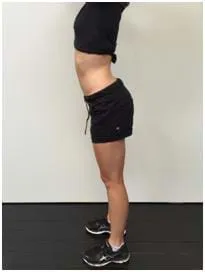
Neutral pelvis. This picture is an example of a neutral pelvis where the bones at the front and the bones at the back of the pelvis and nicely level creating a subtle low back curve. This is the ideal zone to aim to hold your pelvis as you run as it allows for postural control, movement efficiency and great alignment of both the back and the hips.

Now for the most important bit!

  • Forward lean of the body over the hips

It is very important when running to have a slight forward lean of the body. This comes about by bringing your body forward over the hips, so that from a side view you head, shoulders and chest are slightly in front of the hips. Coaches again may say “imagine your breastbone sitting just in front of the pubic bone”.

Runners often go wrong by holding themselves extremely upright with their head and shoulders tacked directly on top of their pelvis or even behind it. This can lead to a heavy heel-strike that lands in front of the body, creating harsh ground reaction forces that propel the body backwards and upwards, which is a waste of energy and an injury waiting to happen!

This picture above is an example of a heel strike in front of the body, with the trunk excessively upright and the pelvis tilted forward. Note how the foot is out in front of the hip area, increasing the stresses through the whole leg with each foot fall. This is not ideal.

If you achieve a slight forward lean from the hips you are more likely to achieve a mid-foot strike underneath or behind the body. Achieving a mid-foot strike improves the body’s ability to absorb and recoil ground reactions forces and achieving this foot strike underneath or behind the body will in turn propel the body forward, improving your speed!

This picture is attempting to re-enact a forward lean and a mid-foot strike that land underneath or even behind the body (we have exaggerated the forward lean for understanding). Note how the foot now falls under the hip, better absorbing the ground reaction forces of each foot fall. This is ideal in preventing injury and improving running efficiency.   

  • Feet

Another thing to think about in regards to your feet is how wide or narrow your feet land. I want you to imagine you have a line on the ground directly under the middle of your body. You want your feet to land either side of the line. Therefore, you do not want to run with your feet too wide nor do you want to run with you feet crisscrossing over each other and over that imaginary line.

Well that takes you from head to toe, its time to wrap things up!

If you want to check your running technique with your Fix Program physiotherapist, here’s what to do:

  • Find a treadmill, a friend and smart phone – Ask your friend to take a video of your running on a treadmill with your smartphone
  • It is best to have spine and pelvis somewhat exposed, so for males it is best to take the video will your top removed and for female it is best if you tuck your top up into your bra
  • Another helpful tip is to find the little boney bits at the back of the pelvis and use a pen or marker to draw large circle over each boney divot. This is to keep an eye on your pelvis whilst you run
  • Run for at least 2mins to warm up and get into your running groove
  • Get your friend to take a 30 second video of your from behind, and then a 30 second video of you from the side. Make sure the video can clearly see your whole body from head to toe, including where your foot is landing on the treadmill
  • Then book a consult with your Fix Physiotherapist and bring in your video for analyze and personalized posture and running tips.

Read More

Showing 2 of 2 articles by Jaclyn Thurley

Fix News