The Fix Program Blog

4 Dec 2013 BY Tabitha POSTED IN Pilates

Explain the Pilates Cue – Sticky Feet

Imagine chewing gum under your feet and make your techniques on the mat better 

We are back with another instalment of Explain the Cue, and this month we are looking at the motivation for “sticky feet”. You will hear us use this cue whenever we are doing mat Pilates exercises in single or double float. 

The exercise

Start by lying on your back, knees bent. Use a towel to make sure your neck is well supported. Concentrate on your pelvis, feeling for the position where your tailbone feels flat on the mat – notice that this gives you a neutral, small curve in your lower back, away from the mat.

Take a breath in to prepare, deep and wide. As you breathe out, lift the pelvic floor, deepen the navel towards the spine, and lift one leg. Hold there for a deep and wide breath in and, as you breathe out, lift the pelvic floor, deepen the navel towards the spine, and lower the leg. Alternate legs and repeat 8-10 times.

 The goal of the exercise

Like many exercises in Pilates, this seemingly simple, easy movement is designed to activate your deep abdominal muscles (transversus abdominus) and the pelvic floor – your pelvic stabilisers or ‘core’. Once your core is properly activated, your lower back and pelvis will stabilize your entire body as you move your legs throughout the day.

To do the exercise correctly, the tailbone must stay flat on the mat, not digging in or peeling off, and the lower back curve must be maintained – no arching or flattening. If your pelvis and lower back don’t stay in this position, the target muscles will not be activated, and you will be moving your legs for nothing! 

So how does chewing gum fit into all of this?

This is where “sticky feet” can help. Each time you start to lift a foot off the mat, imagine that the mat is coated in a sticky substance – like chewing gum – preventing you from pulling it off quickly. In response, lift the heel first, rolling through the foot, so your big toe is the last thing to leave the ground. This allows for you to really prepare the muscles about the pelvis, turning them on and being mindful of your pelvis posture not changing.

Keep this ‘stickiness idea’ going throughout the exercise! As your leg lifts through the air, imagine it is moving through a thick fluid – like honey – so that the movement is slow and the leg feels heavy as it moves. As you lower the leg, again imagine pushing it through thick honey, touching the mat with your big toe very lightly and slowly, softly, reversing the lifting motion, rolling your foot down as if you are trying not to squash something soft and fluffy – like cotton wool.

These visualization cues slow down your movements and ensure you maintain full control. This will ensure your lower back and pelvis stay steady, stable and anchored, which will fully engage the deep core muscles both before, during and after you lift your leg. Imagining your sticky feet will also stop muscles about the hip and leg engaging and working in place of the real target- your pelvic stabiliser muscles.
4 Dec 2013 BY Katrina Tarrant POSTED IN Back Pain

Office chairs for good neck and back posture

Does your chair fit?

Chairs for home and the work place are designed for the average height and build. But what about for those who are at either end of the bell curve? Matching the right chair to the individual should really be as important as have the right fitting shoe, especially for the desk worker who sits all day.

In reality, in offices everywhere, this is not the case. Companies tend to buy chairs in bulk and all of the same make and size. Does one of these common scenarios sound like you?

  1. Tall people sit in standard seats with too much of their thigh unsupported and hanging in front of the chair.
  2. Short people sit in standard chairs that are too large and cannot get their bottoms to the back of the chair, or if do, have their feet swinging and not firmly on the ground.

office chairs

How do you know if a chair fits you properly?

There are 3 important dimensions to measuring a well fitted chair for any individual.

  1. Can you easily get your hips and bottom back into the seat with the backrest supporting your back?
  2. When you are seated back into the chair, do your feet sit firmly on the ground with your knees and hips at a right angle?
  3. Is there a 2-5cm gap between the front edge of the chair and the back of your knee when you are sitting well into the back of the seat?

If you answered ‘no’ to any of these questions, then your chair should be modified or changed altogether. Office chairs do offer great adjustability such as a seat slide, and gas compression chambers for lift and tilt. Seat depths, heights and tilts can therefore be altered up to a point for the average sized of us. However, for the petite and larger of us, there are chairs out there that would better suit you.

I would suggest that if you are one of our smaller or larger friends, speak to your HR department or physiotherapist about whether your chair is adjustable enough or whether another new chair is really the answer.

Just like Golidlocks and the three bears, there is a seat size best for everyone, no matter how big or small.


12 Nov 2013 BY Katrina Tarrant POSTED IN Exercise , Pilates

Katrina’s Top 3 Pilates exercises for rediscovering your buttock muscles

Do you suffer from ‘gluteal amnesia’? Pilates can help 

Thanks to a lovely Fix Program regular, I had such a laugh reading this article about men over 40 losing their buttocks. Girls, don’t laugh - we tend to lose them too. Men’s tend to disappear around to the front to their bellies and we women seem to have them slide down the backs of our legs. 

http://www.afr.com/Page/Uuid/033a59e0-39fb-11e3-a334-c26c4e617206 

But is all seriousness, the buttock muscles are terribly important in supporting our pelvis and back, holding our hips in a good alignment in our pelvis and in providing us with the power to get up out of seats or to walk and run. Underactive and weakened gluts will result in a greater instability about the hip and pelvic regions. This can result in an increased load transferred to the lower back above and to the hamstring muscles below.

Some of us can feel that our hamstring muscles seem to become tighter as we get older. The hamstrings are a powerful and often over worked group of muscles running from your sit bones of your pelvis to the backs of your knee. If you once had quite flexible stretchy legs and hamstrings and now notice they are becoming tighter and stiffer, then perhaps your buttock muscles are weakened? Perhaps you are reliant on these hamstrings for more power and stability about the pelvis in your day than previously? Is there an imbalance about the muscles of your hip and leg?

Has your brain developed ‘gluteal amnesia’?

So how do you ‘find’ your buttocks again? The solution is often a simple one, but also quite a challenge for some brains! Often you need the kind and expert assistance with appropriate cues from your favourite physiotherapist to discover these muscles again. Here are my top 3 Pilates exercises to firstly find, awaken and then challenge your buttocks.

Step 1: Let’s find our buttock muscles again with ‘Virtual reality leg lifts’

Leg lifts to strength buttock

Lie on your tummy with your knee bent to 90 degrees. Imagine your thigh is stuck to the mat and unable to lift off.

Gently lift your pelvic floor muscles and deepen your navel, becoming aware of the subtle tightening between your hip bones and lower belly coming off the mat. Try holding these muscles on while you breathe. Next, imagine you are lifting the foot of your bent leg towards the sky. But remember, you can’t as it is stuck to the mat.

Where do you notice the muscle activating? Is it in your buttock region or down the back of your leg?

If you feel that your buttock is not engaging, try placing your hand on the buttock and imagine very gently holding a piece of paper between your buttock cheeks. Feel it now?

So, try again. Lift your pelvic floor, gently deepen your navel, imagine the paper held gently between you cheeks and then an imaginary lift on your foot towards the sky. Any luck?

Practice, practice again- it is really a brain challenge! This is the hardest step – rewiring your brain to habitually activate your buttock. If all else fails, practice on the other side and see if you can activate your buttock on this side before returning to the other.

You really must master this before progressing to step 2.

Step 2: Awaken your buttocks with great squat technique and side stepping squats

squat with theraband front squat with theraband side

squat with theraband lunge left squat with theraband lunge right

We should all know how to squat safely but here’s a quick recap.

Standing with your feet hip width apart, find your pelvis neutral posture. Become aware of your pelvic floor muscles lifting and abdominals deepening as you lift through your waists gently. Fold your trunk over your hips as if you were aiming to sit onto a chair, your knees bending and your weight shifting into your heels. Remember your tall waist posture and unchanging spinal curves. AS you push up to a standing posture, push through your heels and be aware of your buttock muscles activating.

You can make this more challenging with your theraband tied around your knees, or with sidestepping squats across the room. Remember your sinking hips, folding trunk, tall waists and pushing up through your heels. When sidestepping, feel your leading leg doing most of the work.

Wake up those buttocks.

Step 3: Challenge your buttocks and build endurance with single leg squats, step-ups and jumps

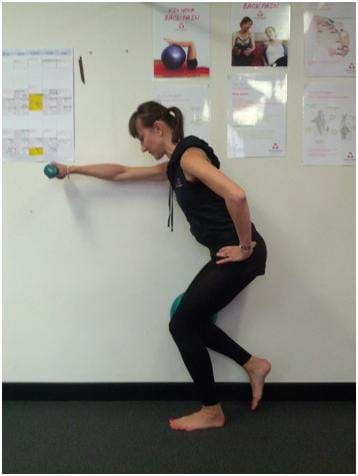
single leg squat - up single leg squat - down

So now you have found your buttocks and your brain knows what it’s like to use and feel them, you can really go for it. Single leg squats, with or without weights, lunges, step ups onto a step or parkbench. All of these will build endurance in your new found gluteals and give you a shapely derriere.

Remember the basics – good pelvic posture (‘neutral’ and no tipping sideways), tall waists, pelvic floor and deep abdominal engagement and pushing through your heels. Even a cupped hand over the buttock cheek will help to reinforce to your brain that you are activating well and feeling that lovely bulky butt!

Good luck rediscovering a shapely behind and giving your back, posture and tight leg muscles a lending hand too.


Fix News