
Pilates and Hip Stability
Hip injuries are often hard to diagnose and can be often confused with pain radiating from the pelvis or lumbar spine. Hip pain can often be accompanied by lumbar and pelvic pain also.
Today we will explore the hip joint a little more.
Anatomy of the Hip joint
The hip is one of the largest weight-bearing joints in the body. When it’s working properly, it lets you walk, sit, bend, and turn without pain. Unlike the shoulder, the hip sacrifices degree of movement for additional stability. To keep it moving smoothly, a complex network of bones, cartilage, muscles, ligaments, and tendons must all work in harmony.
The hip is a ball-and-socket joint where the head of the femur articulates with the cuplike acetabulum of the pelvic bone. The acetabulum fits tightly around the head of the femur. The ball is normally held in the socket by very powerful ligaments that form a complete sleeve around the joint (the joint capsule) and the socket is made deeper by strong tissue called the labrum.
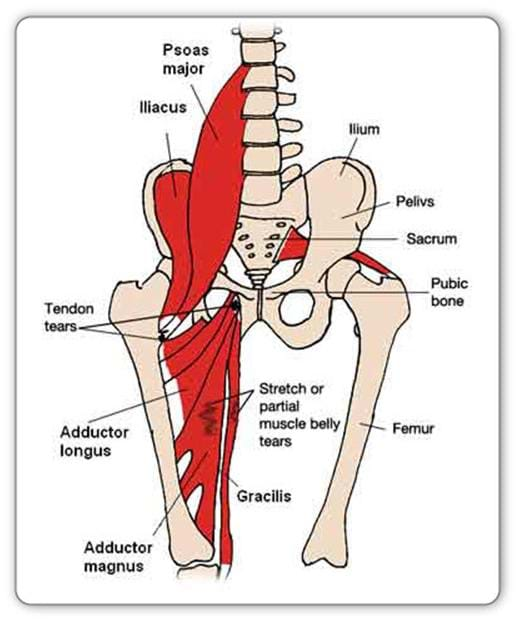
Hip injuries
Pain from a hip joint can be felt in a number of areas, with the most common being deep in the hip, groin region, outside hip area and lower back. The pain is commonly a dull ache, and can sometimes be associated with a clicking or catching sensation in the groin.
Common injuries involving the hip area include:
- Iliopsoas (hip flexor) strains and muscular dysfunctions. This large muscle includes the 2 muscles iliacus and psoas major muscles that pass across the front of the hip joint. They travel deep into the pelvic cavity to attach to the lumbar spine vertebrae. This is a strong flexor of the hip and is often over-active due to weaknesses about the pelvis.
- Adductor strains (groin muscle strains). These are common in sports with a lot of directional changes and present with a very localised and acute pain.
- Hip joint injuries which can involve the joint tissues and cartilage. These include traumatic injuries such as would sustained in a motor vehicle accident, or ‘wear and tear’ overuse injuries due to poor biomechanics of the hip joint sitting in the pelvis. Overuse injuries include osteoarthritis, joint capsule synovitis and labral tears.
- Nerve problems such as piriformis syndrome where the sciatic nerve can become hypersensitive in the buttock region and refer symptoms into the deep and outside hip regions.
Thorough assessment of the hip, pelvis and lumbar spine is warranted with anyone presenting with pain in this area as the causes can be multifactorial or sometimes difficult to localise.
Pilates strengthening for the Hip
As you will be aware, Pilates or core stability can help to establish an improved pelvic posture and enable the pelvis to act as a solid, stable and efficient foundation for your trunk above and hips below. Targeted strengthening, therefore, incorporating Pilates for those with long standing hip pain has shown to significantly improve pain and function.
It is good to remember that the body works as a whole and when a certain body region is inefficient or in pain, the whole system will alter as the body finds a new way to move. This is called movement dysfunction and often causes pain, quite often somewhere else in the chain.
Here are a few interesting facts about the changes we see in the pelvic strength and stability in those with hip pain:
- Painful or over-active hip flexor (iliopsoas)muscles can slowly weaken the deep abdominal muscles that support your spine
- The timing of muscular contractions that occur ( beyond your conscious control) in the pelvis and spine to make you stable as you move can alter, causing an inefficient and unstable pelvic foundation
- The timing of muscles to control your hip can also alter, causing a weakened buttock muscle system and cause your leg muscles to over work and become tight (such as those hamstrings).
So as you can see, learning to activate and retrain your pelvic muscles can improve your hip control also. Exercises should target the following muscle groups:
- Pelvic floor and transversus abdominus ( deep abs)
- Gluteus maximus
- The deeper hip stabilisers such as gluteus medius, gluteus minimus and quadratis femoris ( the ‘match box muscle’)
The best thing to do if you suffer from groin, hip or buttock pain, is to visit your physiotherapist at The Fix Program for a full assessment and prescription of an exercise program that is right for you.