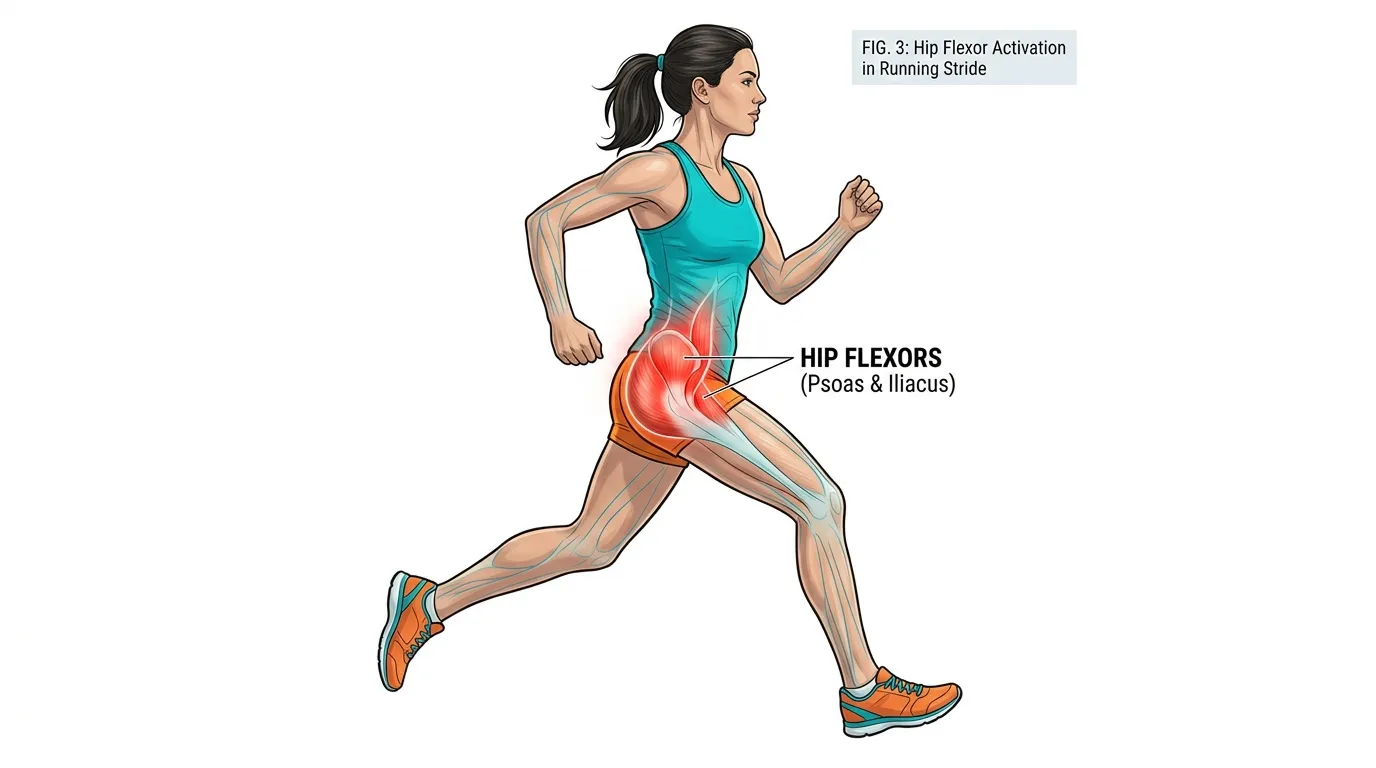
You’ve heard of tight hamstrings. Tight calves. But when was the last time you thought about your hip flexors? If you’re like most runners, probably never — until they start causing problems.
Your hip flexors are a group of muscles at the front of your hips that lift your knee toward your chest. Every running stride uses them. Yet most runners stretch their hamstrings religiously while their hip flexors tighten into rocks, quietly costing stride length and inviting injury.
This is the routine we give runners. For the anatomy and why these muscles grip in the first place, start with where your hip flexors are and what they do.
Why hip flexors matter for runners
When your hip flexors are tight, they pull your pelvis into an anterior tilt — imagine spilling water out of the front of a bucket. This creates a cascade of problems:
- Your lower back arches excessively, causing compression and pain (see core stability vs postural control)
- Your glutes get stretched and inhibited, unable to fire properly (hello, dead butt syndrome)
- Your stride length shortens because tight hips can’t extend fully
- Your hamstrings work overtime trying to pull your leg back
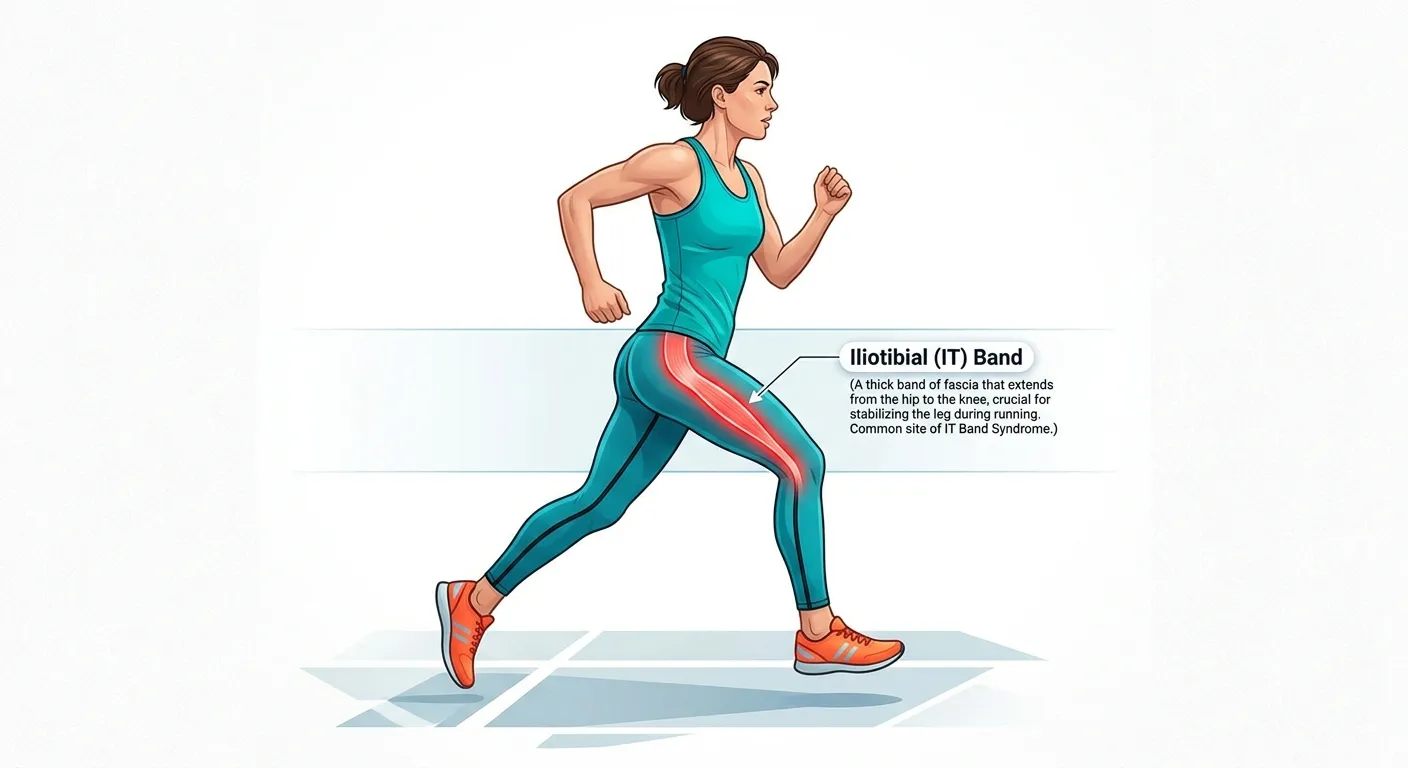
- Your knee tracking suffers, contributing to runner’s knee and IT band syndrome
Tight hip flexors don’t hurt the way a calf cramp does. Instead, they show up as that nagging lower back ache after hills, the stiff feeling when you stand up from your desk, or the sense that your stride just isn’t opening up the way it used to.
The sitting problem
Here’s the modern curse: we sit. A lot. And sitting puts your hip flexors in a shortened position for hours. Your brain learns this as “normal.” When you stand up, those muscles resist lengthening. They adaptively shorten.
Runners often think they’re exempt because they exercise. But 30–60 minutes of running doesn’t undo 8–10 hours of sitting. Your hips don’t care about your weekly mileage if the rest of your day is chair-bound.
The result? You start runs feeling stiff. Your first kilometre feels like your hips are stuck in second gear. You might unconsciously shorten your stride to avoid the discomfort of full hip extension.
Are yours tight?
There are four quick checks worth doing, and we’ve written them up with the reasoning in the hip flexor muscles post — the standing test, the Thomas test, and what to watch for when you walk and run. Go and do those first, because the answer decides how hard to push here.
One thing to rule out: if what you feel is a sharp pinch at the front of the hip rather than a general stiffness, that’s usually a different problem. Why the front of my hip pinches covers it, and stretching it harder will make it worse rather than better.
The release routine
The fix isn’t complicated, but it requires consistency. These are the five that reach the hip flexors properly, in the order we usually give them.
Kneeling hip flexor stretch — the foundation
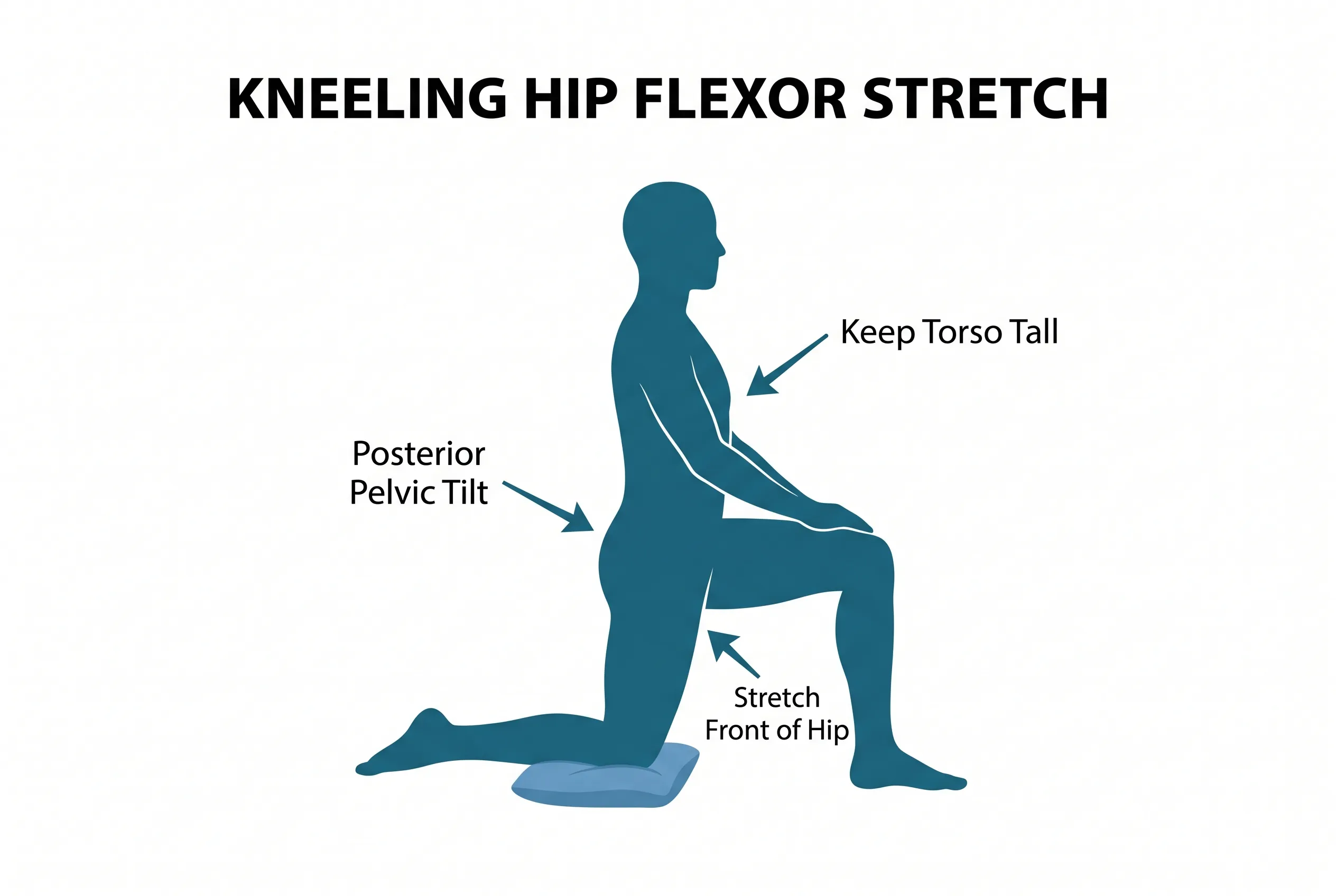
Targets: psoas major, iliacus, rectus femoris
This is your bread and butter stretch. Done right, it targets the deep hip flexor muscles that connect your spine to your leg.
- Start in a half-kneeling position on a comfortable surface (use a cushion under your back knee if needed)
- Place your right foot flat on the ground in front of you, knee bent at 90 degrees
- Keep your left knee on the ground behind you
- Critical step: Tuck your tailbone slightly by drawing your pubic bone toward your belly button (posterior pelvic tilt) — this flattens your lower back
- Place both hands on your front thigh for balance
- Gently push your hips forward until you feel a stretch in the front of your left hip
- You should feel the stretch in the thigh of the back leg, not in your lower back
- Keep your torso tall and shoulders stacked over your hips
- Breathe deeply and hold
- Switch sides and repeat
Common mistakes: arching your lower back, which means you haven’t tucked your pelvis enough; letting your front knee travel past your toes; leaning forward to get more range, which takes the stretch off the hip entirely.
Hold for: 45–60 seconds per side. Frequency: daily, especially after running and sitting.
Progression: raise the arm on the same side as your back leg, reaching up and slightly back to deepen it.
Couch stretch — the deep release
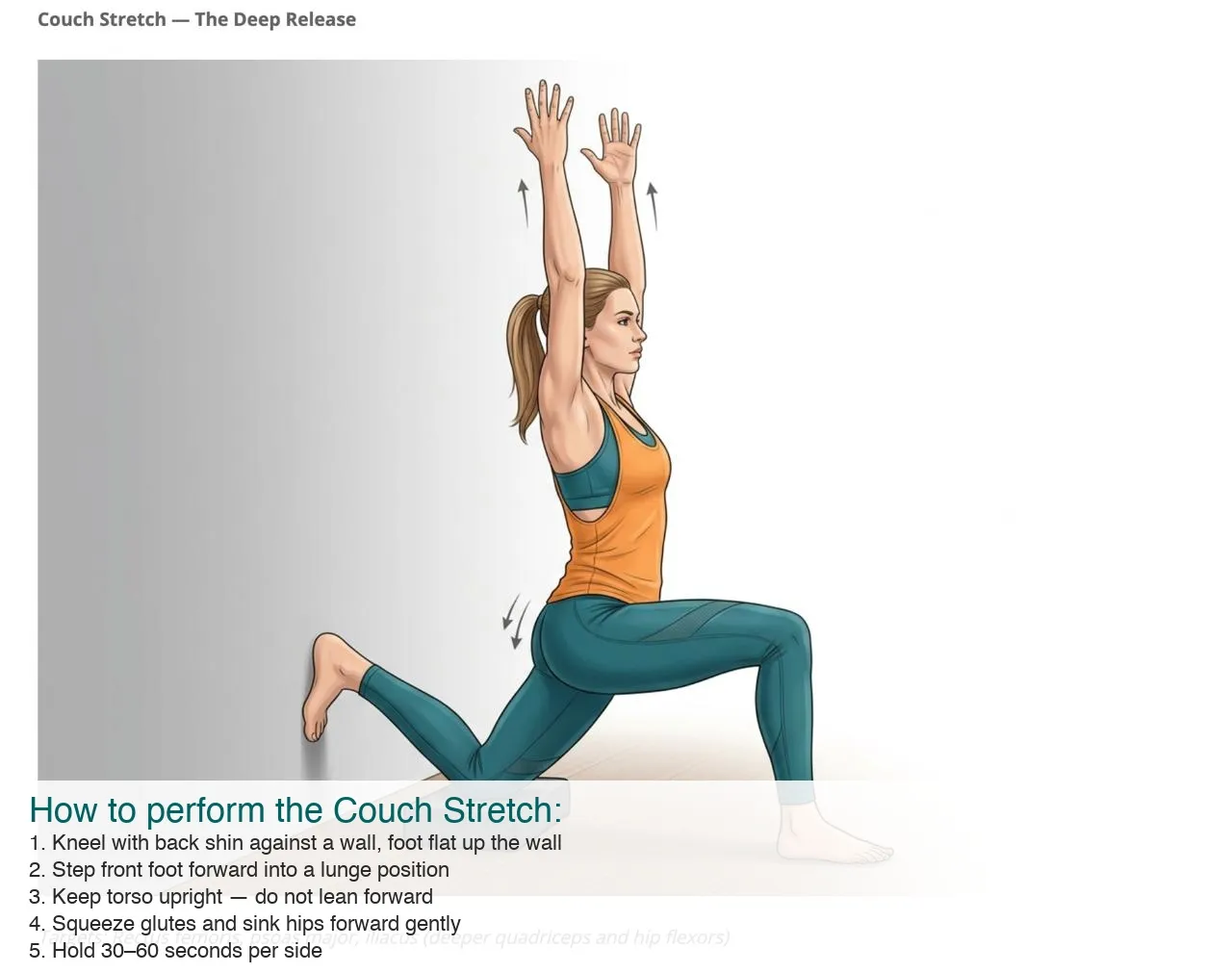
Targets: rectus femoris, psoas major, iliacus
Named for the fact that you can do it against the back of a couch. This takes the kneeling position deeper and adds a quadriceps component the basic stretch misses.
- Place a cushion or yoga mat on the floor near a wall or couch
- Kneel facing away from the wall with your back knee on the cushion
- Bring your back knee right up against the wall, tucking it into the corner where the wall meets the floor
- Position the top of your back foot against the wall (shoe lace side facing the wall)
- Step your front foot forward into a lunge position, knee bent at 90 degrees
- Your front knee should be positioned directly over your front ankle
- Critical step: Tuck your tailbone and engage your core to keep your pelvis neutral
- Keep your torso vertical — imagine a string pulling the crown of your head toward the ceiling
- Gently push your hips toward the wall until you feel a deep stretch in the thigh of your back leg
- If you’re doing it right, the intensity tells you you’re in the right place
- Switch sides and repeat
Common mistakes: letting your lower back arch, leaning forward instead of extending the hip, and letting your front knee cave inward.
Hold for: 60–90 seconds per side. Frequency: 3–4 times per week, or when feeling particularly tight.
Progression: once you can hold it upright comfortably, raise both arms overhead and reach slightly backward.
90/90 hip switch — mobility, not just stretching
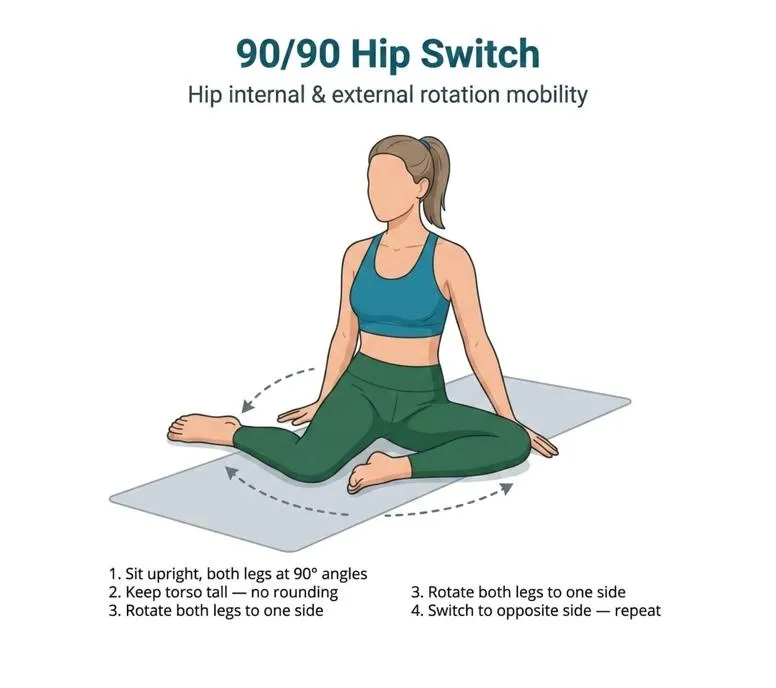
Targets: hip rotators, gluteus medius, tensor fasciae latae (TFL), hip capsule
Tightness isn’t just about length — it’s about how your hip moves. This one builds rotation and control through the full range rather than simply pulling on the muscle.
- Sit on the floor with your legs extended in front of you
- Bend your right knee and place your right foot on the floor in front of your left hip, knee at 90 degrees
- Bend your left knee and take your left leg behind you, also at 90 degrees, with your left foot pointing backward
- Both knees should form 90-degree angles — one in front, one behind
- Sit tall with your spine extended, hands resting on the floor beside your hips for balance if needed
- The movement: keeping both legs at 90 degrees, rotate your hips and pelvis to switch legs
- Bring your left leg forward and your right leg back, both still maintaining 90-degree angles
- Your knees are the pivot point — imagine your pelvis rotating around an axis
- Move slowly and deliberately with full control — no momentum
- Continue alternating sides smoothly
Common mistakes: rushing, letting your knees collapse inward, rounding your back, and letting the trailing foot slide out of position.
Do: 10 switches per side. Frequency: before running as part of warm-up, or daily for maintenance.
Progression: add a forward fold over each front leg before switching.
Upright pigeon — the glute and hip flexor combo
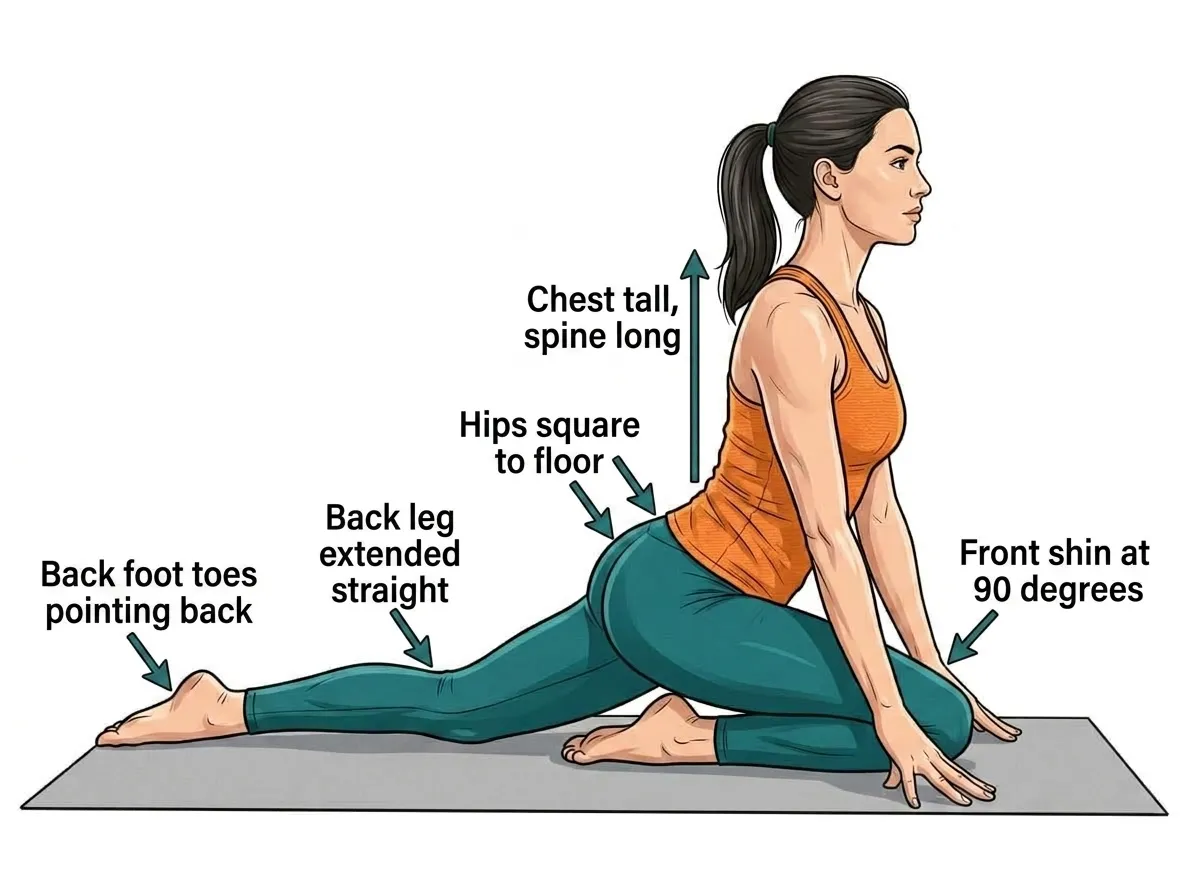
Targets: gluteus maximus, piriformis, deep hip rotators (front leg); hip flexors (back leg)
Borrowed from yoga, this upright variation targets both the hip flexors of the back leg and the deep glutes of the front leg. Efficient, and it does two jobs at once.
- Start in a high plank or push-up position on your hands and toes
- Bring your right knee forward toward your right wrist
- Angle your right shin diagonally across your body toward your left hip/wrist area
- The more your shin is perpendicular to your body, the gentler the stretch; the more parallel, the deeper
- Extend your left leg straight behind you on the floor
- Keep the top of your back foot resting on the floor, toes pointing backward
- Square your hips: gently draw your right hip back and left hip forward so both hip bones face the floor equally
- Place your hands on the floor beside your hips and lift your chest tall
- Keep your spine extended and shoulders relaxed away from your ears
- Gently press your hips toward the floor to deepen the stretch in your right glute
- Switch sides and repeat
Common mistakes: letting your hips roll to one side, collapsing through your lower back, and forcing the front knee past comfort.
Hold for: 60–90 seconds per side. Frequency: after running or as part of an evening routine.
Progression: fold forward over the front leg into a sleeping pigeon. Use a cushion under the front hip if you cannot get square — better supported and square than collapsed and twisted.
Foam roller — the self-massage
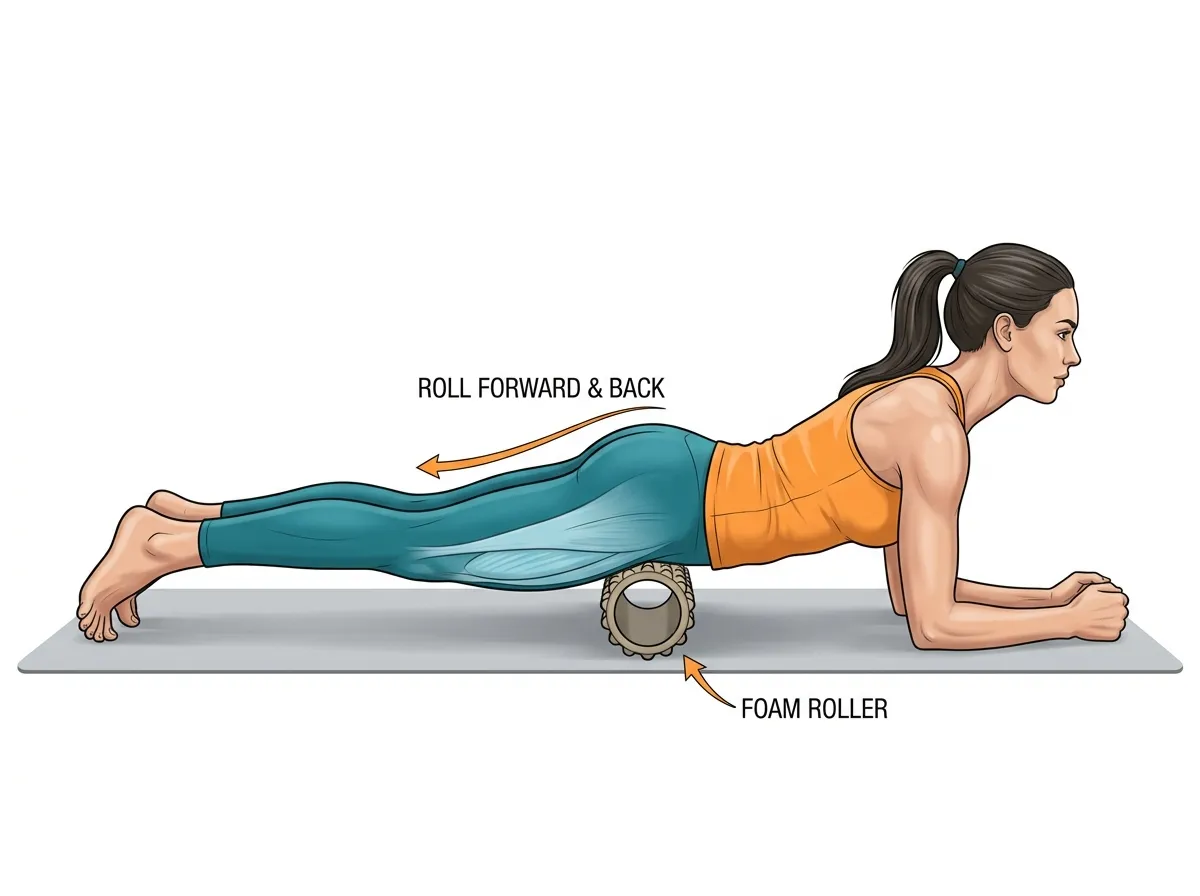
Targets: rectus femoris, vastus lateralis, tensor fasciae latae (TFL), iliotibial band (ITB)
Sometimes stretching isn’t enough — the tissue needs direct pressure to release. This targets the spots your foam roller usually misses.
- Place a foam roller on the floor in front of you
- Get on your hands and knees with your wrists under your shoulders
- Lower down onto your forearms, elbows under shoulders, hands together or in fists
- Extend both legs straight behind you into a forearm plank position
- Position the foam roller under the front of your right hip, just below your hip bone
- Your left leg should be relaxed and extended behind you, toes resting on the floor
- The movement: slowly roll forward and backward about 10–15 centimetres
- Pause on any tender spots for 20–30 seconds and breathe
- Gradually work your way down toward your mid-thigh over 2 minutes
- Focus on the area just below your hip bone and slightly to the outside — this targets the iliacus and tensor fasciae latae, often neglected but commonly tight in runners
- Switch sides and repeat
Common mistakes: rolling over the bone itself rather than the soft tissue below it, rushing, holding your breath, and going so deep you feel sharp pain rather than discomfort.
Roll for: 2 minutes per side. Frequency: post-run or daily if chronically tight.
Progression: move to a harder ball for deeper, more targeted pressure.
Strengthening: the other half
Stretching tight hip flexors is only half the battle. You also need to strengthen the muscles that oppose them — your glutes and hamstrings — to hold your pelvis in a neutral position.
From the dead butt syndrome post: glute bridges, single-leg bridges, and hip thrusts. These lock in the gains from your stretching by teaching your body to maintain that open hip position under load.
Strength plus flexibility is mobility that lasts. Skip this half and the hip flexors shorten again within days.
The bottom line
Your hip flexors are the silent thieves of running performance. They shorten from sitting, tighten from running, and quietly pull your body out of alignment.
You don’t need to become a yoga master. Five minutes of targeted stretching daily — especially after sitting and before running — can open your stride, reduce back pain, and let your glutes do their job. Pair it with glute activation and the hip stability work in Pilates and Hip Stability for complete hip health.
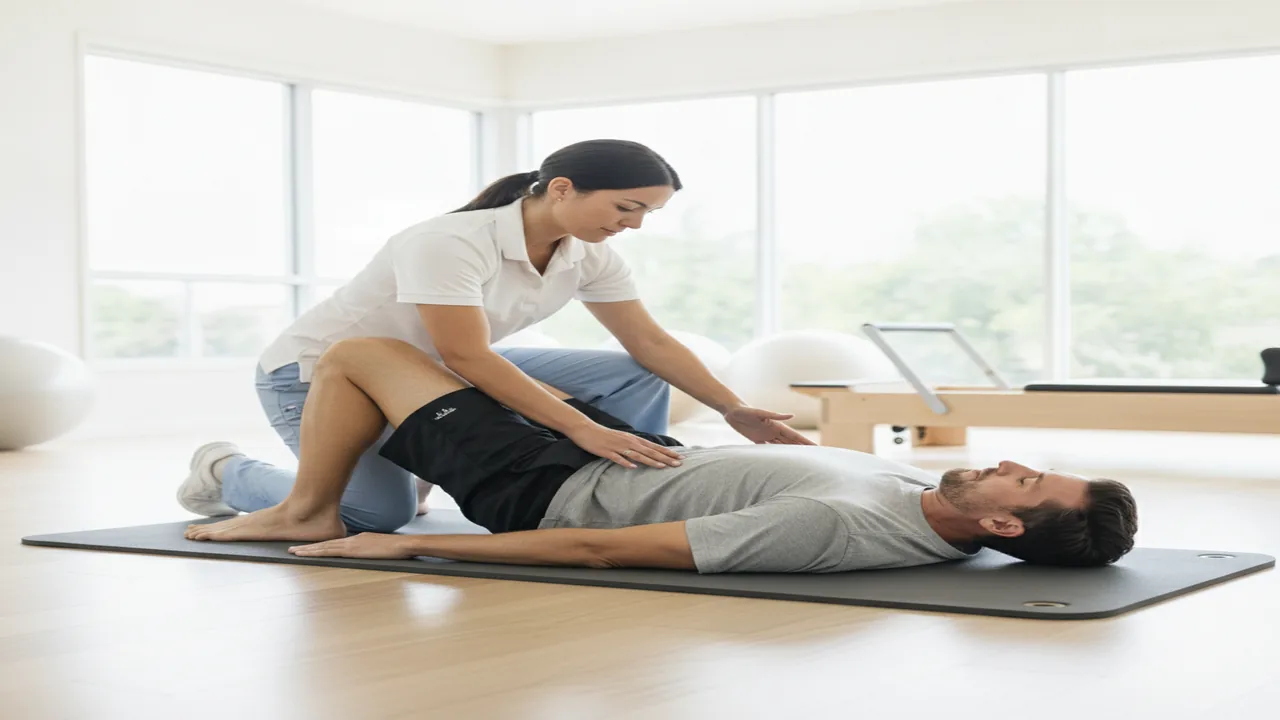
If it is not shifting, our physios can look at how you run and how your pelvis is sitting, because sometimes the hip flexors are compensating for something further up. Book in with the studio and we will work out which.
If it is not shifting, our physios can look at how you run and how your pelvis is sitting, because sometimes the hip flexors are compensating for something further up. Our hip pain page covers how we approach that.
Loosen up at home with our Motion is the Lotion: Soften the Front Hip class — 15 minutes to happier hips.
For the background on these muscles, read hip flexor muscles: where they are and why they grip.