
The Fix Program Blog

Physiotherapy, Pilates, pelvic floor health and pregnancy

What makes The Fix Program a wonderful clinic for women?

Since 1999 we have taught thousands of women and men how to strengthen their backs, hips, pelvic floors and abdominals through a mix of Pilates, Yoga and core stability exercises. And yet we offer so much more.

As physiotherapists and women ourselves, we are passionate about the wellness of all women. We are expert clinicians in the diagnosis and management of conditions unique to women at all stages of life.

The active woman.
From niggly backs and hip pain, sore knees and feet, computer necks and headaches, we treat muscle and joint pain to get you back to what you love doing most. Massage, joint re-alignment techniques, postural awareness and exercise prescription are a start to how we achieve this. Education, empowerment and getting to the cause of the injury is our goal.

Incontinence, pelvic pain and painful sex, endometriosis and bowel troubles can also trouble the active woman. Bladder leaks with coughing, laughing, exercising or running is not normal and can be treated. Pain in the pelvis or when having sex is not normal. You do not have put up with it. Our Women’s Health physiotherapists are qualified to help you get back your pelvic floor function.

The pregnant woman.
In pregnancy, we want the best for you and your baby. Pelvic girdle pain, rib pain, back pain and other associated pregnancy aches can all benefit from physiotherapy. Pelvic floor weakness, abdominal separation and safe exercise while pregnant are issues we can help you with. You do not have to stop exercising just because you are pregnant. In fact, the right exercise can help with controlling gestational diabetes, cardiovascular health of mum, control weight gain and protect the spine and pelvis from the big changes seen in pregnancy. A strong body can support your changing posture and prepare you for labour and when baby arrives.

The new mum.
So, now that you have your baby, your body may still not feel quite right. Ongoing back and pelvic pain, upper back pain and pelvic floor issues such as incontinence and sensitivity are very common. When am I safe to exercise and what can I do? How do I bring back my belly separation and pelvic floor strength? Do I have, or am I a prolapse risk? What effect has breastfeeding on my hormones and return to exercise?

New mums are a special bunch and need special care. We can internally assess the pelvic floor function for any weakness or prolapse, manage abdominal separation, pains and aches, and educate and get you back to exercise and feeling in control of your body.

Every Woman.
It is well known that physios can help with muscle and joint injuries, postural pain, alignment and exercise. It is not widely known however that specialised physiotherapists can manage pelvic floor problems. At The Fix Program, we do just this. We can help you if you have:

  • Urinary incontinence or poor bladder control
  • Bowel incontinence and constipation
  • Over active bladder and urge incontinence
  • Pregnancy and post-natal pelvic floor weakness, scarring or pain
  • Vaginal prolapse (also known as pelvic organ prolapse)
  • Painful sex and pelvic pain.

Pelvic floor problems are more common than you think, and it is our mission and passion to get the conversation started. To seek help and to gain back pelvic floor control is life changing and sometimes takes a little bravery. Caring, sensitive and thorough assessment and management for each woman is our focus. We understand that every woman is different.

What do I do next?

Contact us. You don’t need a doctor’s referral to see our physiotherapists. We’ll be happy to chat about your needs.


26 Apr 2016 BY Katrina Tarrant POSTED IN Exercise , Physiotherapy

Finding the right running shoe

Surviving the shoe mine field by Julian from Sydney Running Centre

running shoes

The question I have been asked the most over the last 15 years in the running shoe game is “so what’s the best running shoe?” It’s always so difficult to come up with a short answer to this question but I’ll give it a shot……“there is no such thing!”

 Good running shoe manufacturers build their range of shoes based on 2 key areas:

  • Different foot types (such as is the foot high arch, low arch, wide or narrow?)
  • The type of running/training you are doing (is the shoe for road or long distant racing, short fast running, long slow running, walking and so on?)

This means that within the huge range of shoes you will see on shop walls or advertised online, some will suit you down to the ground and others will be completely wrong for you. You cannot choose running shoes based on colour alone! You need to combine information from the 2 key areas mentioned above to help find the right shoe but this can be difficult because how does one know “what’s what” when it comes to running shoes?

A lot of people will search online and read forums and reviews on running shoes. Whilst this can sometimes be helpful, there is a lot of misinformation online about shoes which will often point you in the wrong direction. It is also hard to decipher the information because every brand’s advertising is aimed at convincing consumers that their products are superior to all others.

To find the right shoe…

 At the Sydney Running centre we know which shoes will suit your feet. How do we do it? We will ask questions such as:

  • What kind of exercise will you be doing?
  • What shoes have worked or not worked for you in the past?
  • Are you carrying any injuries or niggles as a result of your exercise?
  • Do you wear orthotics?

We will then have a look at your feet and walking gait to identify the shape of your feet, whether or not you pronate (roll in through your arches), supinate (roll out through your mid-foot) or neither (neutral). With all this info combined we will then recommend some shoes that are in the right category for you -usually 2 or 3 pairs.

The next step is to try them on, lace them up properly and have a walk around – like any shoe they need to feel comfortable to you. A good way to describe the way a shoe should feel is “comfortably firm” this means that you have a feeling of support from the back of the heel through to where the laces end and then enough wiggle room in the toes. “The piggies need to wiggle!”

I’ve found the right pair, but how long will they last now?

Another common question I get asked is “how long should shoes last?” Yet again it’s quite difficult to answer this as people wear shoes out at different rates. The best guideline I can give is this:

  • If you use your shoes 3 times a week or more for exercise that involves impact on hard surfaces you should replace them every 12 months with 18 months being the absolute cut off. A 12 month old pair of running shoes can still be completely intact and have no obvious signs of excessive wear but the likelihood is that the cushioning in the shoe has compressed to a point that it will no longer provide the necessary shock absorption.
  • Some people say they know their shoes are finished because they all of a sudden “feel it” in their knees.
  • Running or walking around in shoes that are worn out is just as detrimental as wearing shoes that are not right for your foot type so it pays to get the right shoes and replace them before they start causing damage.  

sydney running centre

The Sydney Running Centre has been operating in the Edgecliff Centre for over 15 years. Father and Son team Phil and Julian have a wealth of knowledge when it comes to running, walking, shoes and feet.

If you have trouble finding comfortable shoes then pay a visit to the Sydney Running Centre and mention this article to receive a 10% discount off the retail price.

http://www.sydneyrunningcentre.com.au/


Periods and back pain

Why does my period make my back and pelvis hurt?

To understand why the back or pelvic hurts during a period, we need to understand the menstrual cycle and the changing levels of hormones. The menstrual cycle is made of a few main phases.

  • The first phase, which is menstruation, begins on the first day of your period. During menstruation hormones, oestrogen and progesterone, are relatively low.

Menstral phases

  • In the second phase, also known as the follicular phase, FSH (or follicle-stimulating hormone) is released, which causes immature eggs to develop. These follicles cause a lot of oestrogen to be produced, and the lining of the uterus thickens, for a possible egg to be embedded.
  • The third phase in ovulation, and is when a mature egg is released from the ovary. It is triggered by an abrupt rise in LH (or luteinising hormone). At ovulation, the cervix moves higher and its opening widens. The release of the egg and the movement of the cervix is why some women experience cramps or aches at ovulation, and why some women experience ovulation spotting. After ovulation, the egg enters the fallopian tube and moves along the uterus.
  • The fourth phase, also known as the luteal phase is when oestrogen production drops and progesterone increases. This further thickens the uterine lining to allow for a fertilized egg to embed. If fertilization doesn’t occur, the egg breaks down, and progesterone levels drop, which disintegrates the uterine lining, in preparation for a period. This drop in progesterone is why some women experience mood swings, bloating, tender breasts or tiredness.

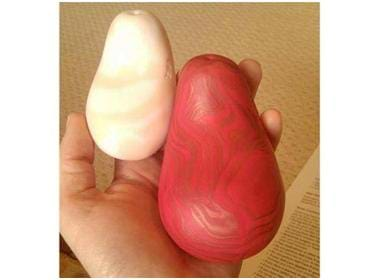
During the period, the broken-down lining of the uterus flows down through the cervix and out of the vagina. When you have a period, the uterus swells and expands and can become almost double the size and weight (pictured below).

Uteris size

Understanding the anatomy of the pelvis can help us understand why the back and pelvis can hurt during a period and during this time when the uterus is so enlarged. Here are some explanations:

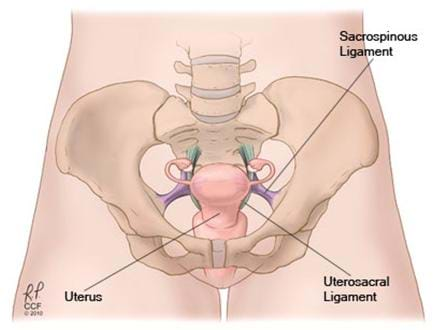
  • Firstly, the uterus is suspended in the pelvis to the sacrum (pictured below), which is the triangular bit of bone between your lower back and your tailbone. You can feel the top part of your sacrum, where the dimples in your lower back are. These ligaments are called the uterosacral ligaments. When the uterus swells, this puts pressure on the uterosacral ligaments, which can then create a dragging feeling, heaviness or pain on the sacrum and tailbone.

Periods

  • Secondly, to push the uterine lining out through the vagina during menstruation, the uterus muscle contracts, and if it contracts sharply, it can make you feel strong cramps. Hormone-like substances called prostaglandins trigger these contractions, and prostaglandins are also involved in pain and inflammation processes. If a woman has high amounts of prostaglandins, she can have more severe menstrual cramps.
  • If a woman has endometriosis, cells that resemble the lining of the uterus exist on other places within her pelvis, such as on her bladder, bowel, or vaginal walls. These cells can be triggered with a period and cause more pain and inflammation, which is why women with endometriosis tend to have more severe period pain.
  • Sometimes the uterus isn’t aligned neutrally within the pelvis, and this can contribute to pain that may be one-sided or to pain in the lower abdomen. The uterus may be tilted to the side or it may be tilted forwards. Visceral mobilization to re-position the uterus well inside the pelvis by a trained women’s health physiotherapist can help bring back alignment to the uterus and surrounding tissues.
  • Often the pelvic floor muscles can cramp because of the contracting uterus and vagina. This can also contribute to an increased perception of period pain, because not only is the uterus contracting, but the pelvic floor and pelvic wall muscles go along for the ride. Over time, these muscles can become stuck in a tight position from overworking for many months or years. Because these muscles also attach to the pelvis, tailbone and lower back they can add to your lower back or pelvic pain. Pelvic floor release techniques by a trained women’s health physiotherapist can release these tight muscles, which can in turn reduce the overall pain during periods.

If you have period pain or lower back pain or pelvic pain, try seeing a women’s health physiotherapist, as very often, having some physiotherapy can significantly reduce or completely eliminate your pain. Their treatment techniques can help with other menstrual symptoms such as spotting, irregular cycles, long cycles, and research is now showing the benefits of physiotherapy for fertility as well.

Join an online class  from the comfort of your home - Katrina the principle physio at The Fix Program has designed a series of pregnancy exercise programs that will help you immensely. 


Fix News