The Fix Program Blog

31 Oct 2013 BY Tabitha POSTED IN Pilates

Explain the Pilates cue – the mango

Holding the ripe mango under your chin 

In your Pilates classes at The Fix Program, you will have heard us reminding you to keep a big juicy ripe mango gently tucked in between your chin and chest. This is another of the many visual cues we use to help you correct your neck and upper back posture, engaging the deep postural muscles that support an ideal alignment.

Why I do I need to think about a mango under my chin?

When you’re sitting or standing for long periods, you might find your neck falling forward, your chin creeping out in front, your shoulders rounding forward, or even all three at once. Desk work and watching TV are when I notice this the most, when it sometimes even feels natural to relax my entire upper body and let it hang loose.

The truth, however, is that this slumping greatly increases the curve (technically the lordosis) of the cervical spine as the upper vertebrae slide forward over the ones below. The spaces between the vertebrae become more narrowed, leaving less room for your nerves to enter and leave the spinal column – this can exacerbate or even cause pain in the neck, head and even arms.

Also, forcing the outer muscles of your neck and shoulder to hold your head so far out increases their tightness and fatigue, causes pain and heachaches that are cervicogenic (which means ‘from the neck’). At the same time, your chest muscles become tight and shorten, your shoulder joints held forward and stiff, and the more you do it the harder it is not to!

So, how do I ‘hold my mango’?

To counteract this, we ask you to imagine that you’re very gently holding a big juicy mango between your chin and chest. Your head will gently be drawn back in line over your body, the back of your neck growing long and tall, and your chin slightly tucking down to gently hold your big mango to your chest. This restores the lordosis of your neck and upper back to its ideal state, optimally spacing out your vertebrae. It also relieves a lot of the weight of the head on your neck muscles – sitting atop your spine allows gravity to take over, relieving that familiar neck stiffness.

But most importantly this postural cue helps us to gently switch on the tiny, deep muscles near your spine in the neck called the deep neck flexors which, when activated properly, should work gently to support your neck in a tall, lengthened, ideal posture as you go about your day and practice your Pilates exercises.

Try to hold your mango very gently, so as not to squish its softness! This will keep your deep neck flexors doing the work and growing stronger, and help to avoid overuse and fatigue of the outer neck muscles.

So always remember your big juicy mango wherever you are, from sitting at work, on the sofa, carrying your shopping or your toddler. This will help you to stay properly aligned and supported to avoid postural neck pain and headaches.


2 Oct 2013 BY Katrina Tarrant POSTED IN Exercise, Pilates

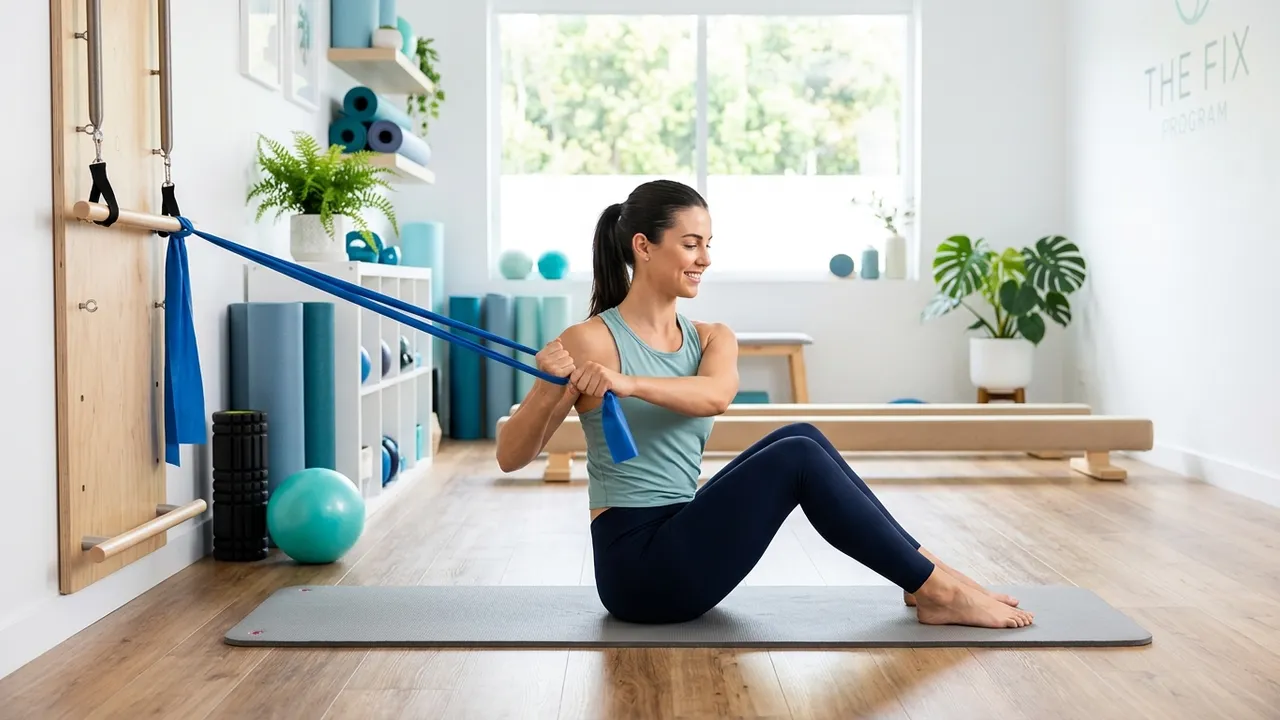
Exercise of the Month: Theraband trunk twists

Think of your ‘tall ribs’ and get twisting

This exercise at a good slow and controlled pace really gets those oblique abdominals and upper trunk muscles going. Remember that these muscles are needed every day for any movement involving a turn of the body. Add to that your great shoulder stability and pelvic control and this exercise is a challenge for the whole trunk. This version has you in sitting, but you could also try it in a static wall squat or deep lunge position.

The Starting Position:

The focus:

  • Sit on a chair or Swiss ball in ‘active sitting’. Active sitting starts with legs hip width apart to your feet, a neutral pelvis posture, long waists and a lifted breastbone.

  • With a partner or your theraband fixed at one end, hold your theraband with clasped hands out in front of your chest.

  • Set your shoulder blades softly and widely into their ‘pockets’ in the upper back and melt the tension away from your neck and shoulders.

  • Imagine you are on a skewer, turning with a beautifully tall and centred axis.

  • Twist with long waists and tallness between all of your ribs each side of your trunk. Think of the rib rack and thick meat between each and every rib.

  • Keep melting through your shoulders and neck and keep stable and neutral on your pelvis.

The Movement:


  • Breathe in deep and wide to prepare. As you breathe out, gently lift your pelvic floor muscles and imagine your hip bones drawing together at the front as your navel deepens.
  • As you next breathe in, turn your trunk against your theraband resistance, keeping your hands in front of your chest at all times.
  • As you exhale, slowly return your trunk to the middle.
  • Repeat to the same side 8-10 times, before changing your set up to turn to the opposite direction.


Tip:

Try this same movement with a partner as you squat against a wall to really challenge your legs and pelvis more so for that complete body workout.


2 Oct 2013 BY Tabitha POSTED IN Pilates

Explain the Pilates Cue - The rack of ribs

The rack of ribs

Have you ever found yourself in a Pilates class wondering why we’re telling you to ‘think long through the waists’ or to ‘melt between the sit bones’? We can hear you thinking ‘What new impossible task will I be asked to do this week – wiggle my spine-toes?’ Explain The Pilates Cue is a new category of articles you’ll see popping up in Fix News over the coming months in which we will look a little closer at all those weird and wonderful verbal cues and uses of imagery we mention so often to aid us during our Fix Program classes.

So why do we love to use these cues at The Fix Program? We know from the research that motor learning and skill acquisition can be greatly improved by the use of visualization techniques. We layer multiple cues which, through practice, reinforce the laying down of new nerve pathways in the brain during exercise and postural practice. This way it will become a new habit for you, even outside the context of the studio.

Let’s get into unraveling our first cue, the ‘rack of ribs’ – which is certainly not an invitation to dinner! Our familiarity with their shape, however, makes it a useful visualization tool which can, through applying the right Pilates techniques, address problems in our posture.

Imagining the iconic meal of ribs, where each individual rib is parallel and separated by even gaps filled with delicious meat. These intercostal muscles (the ‘meat’) should be just as equal between parallel ribs in our own body, making the ribcage equally tall on both sides. For those of us who slouch to one side, we can imagine the result - a tightening of the intercostals muscle space between each rib can become smaller and less even – by thinking of the results on the dish. When the ribs close together like a folded accordion with a slight sideways twist, it is far from ideal in both the culinary and the physiotherapy sense. This poor rib posture can set up poor movement patterns and muscle activations in the trunk, can affect the neck and lower back, change nerve dynamics in the area and even interfere with our breathing.

Putting this into practice, imagine how we might reduce the space between our ribs when we valiantly attempt to ‘glide the shoulder blades down the back’ (a cue for another post perhaps?). When doing arm work and setting the shoulder blades, think of the blades gliding freely over the top of the rack of ribs without causing those ribs to lose their lovely parallel gaps and collapsing downward on one side. Another reason to ‘keep both sides of your trunk long’ (yet another cue)!

Why not try thinking of your rack of ribs next time you’re doing Scissor Arms on the mat or as you stretch into a Wall Twist? And then carry this visualization into functional activities as you carry your child or a heavy bag of groceries or when sitting long hours at your desk.

Then you can get back to dreaming wistfully of dinner.

By Tabitha Webb


2 Oct 2013 BY Tabitha POSTED IN Exercise

So which exercise is best for you?

To cycle, or run or walk – that is the question

cycling image

http://well.blogs.nytimes.com/2013/08/29/ask-well-is-it-better-to-bike-or-run/

I recently came across this article in the New York Times, which briefly discusses the pros and cons of common exercise. I thought I would lay out some of the reasons for choosing or avoiding various forms of aerobic exercise. The three forms of exercise that were compared were walking (6kph), running (14kph), and cycling (28kph).

Firstly, there is weight management. Running is the winner here at 1,000 calories per hour, cycling is close at 850, and walking consumes only 360. Clearly the high-intensity workouts are best. Note also that you need to walk for nearly three times as long as you would run if you wanted to burn the same amount of calories.

In addition, running and cycling (as high-intensity workouts) cause lower blood levels of ghrelin, a hormone linked to hunger, so act as appetite suppressants as well. However these two more strenuous exercises compare very differently when considering impact – as cycling does not involve weight-bearing, injuries and muscle soreness are far less common among cyclists than runners. Walking is by far the least strenuous, of course!

The characteristic shared by all exercises is a positive effect on wellbeing – aerobic exercise leads to cardiovascular fitness, which is linked to lower risk of chronic diseases and an increased lifespan. Additional motivators for us at The Fix Program are that fit people experience less pain, have improved mental health and sleep better.

As with any form of exercise, combining them with a core stability, postural and stretching program (such as Pilates) can reduce risk of injury and improve performance by ensuring your body is working in optimal, stable balance as you train. There is no ‘best choice’ of exercise to pair with such a program and achieve all these benefits – any form, or even a variety, can be modified to best suit your preferences, safety and weight loss needs.

Author Tabitha Webb


26 Sept 2013 BY Katrina Tarrant POSTED IN Back Pain

Pain tales – the over sensitive nerve

sitting at desk

In July’s version of ‘pain tales’ we looked into nerves and how they send messages to the brain (and back again). Nerves conduct messages from our muscles, skin and joints as electrical impulses to and from our brain. Even the brain itself is made up of trillions of nerves and connections, and then there are the nerves that supply to our vital organs.

So what can happen when all of this goes amiss? When nerves become hyper sensitive due to injury, pressure or in chronic pain?

We have all probably heard about brain plasticity. This ability for the brain to change, adapt, ‘be plastic’ in reaction to stimuli can also be demonstrated in the peripheral nervous system. This peripheral nervous system includes all nerves outside of the brain (or central nervous system).

Lets explore…

Nerves are able to conduct electrical impulses or messages via their conductivity. Positive and negative ions pass over the nerve ‘walls’, charging them until the point that an impulse fires along the nerve. This is called an ‘action potential’. Charged ions can rush into the nerve via sensors, also known as receptors or ‘ion channels’. These are made of protein and ‘listen out’ or measure different stimuli. They are specific and specialised for just that stimulus. For example, light receptors in your eyes, or sound wave sensors in your ears.

There are only 3 types of sensors in your nerves for your muscle, skin and bones – one to detect the stimulus of temperature, one for mechanical changes (such as stretching, vibration, pulling) and one for chemical changes (such as adrenaline, acids, endorphins).

Changes detected by these 3 types of sensors will create the influx of ions to create a message that rushes along your nerve pathway to your brain, or back again. You may remember from previous discussions that these messages are NOT pain messages. Pain is the construct from the brain after weighing up all the information that the nerves have delivered for that time and that place.

The most amazing thing about these sensors is that their life is short- only living for a few days. They are always being replaced by new sensors and the type of sensor may change depending on what your brain decides is needed for your best survival. The brain does this by producing sensors proportionate to the stimuli around.

So, for example, if your posture is poor and you have rounded shoulders when you sit all day, the mechanical sensor numbers will be higher than the temperature or chemical ones in the nerves of this area of our body. This is because of the constant pulling loads on the nerves about your neck and upper back through your rounded shoulder and chin poked out. This makes for a very over sensitive area in your body, detecting lots of mechanical changes and forces and producing a higher rate of impulses from these nerves to the brain. Your brain may choose to ignore these, but will be more likely to feel more pain. And this makes for a tired painful neck and upper back. Sound familiar?

So back to ‘plasticity’ (and the good news if you suffer from pain)! The same can happen in reverse. The number of a particular sensor type in a nerve will reduce if the stimulus is less. And a return to a relatively balanced and stable number of each receptor type in all of your nerves. Using the same example of poor posture and rounded shoulders in our neck pain sufferers, better your posture –‘mangoes under the chin’, ‘long tall neck’, ‘lifted breastbones’ – move more, be stronger. This will decrease the mechanical pulling on your nerves up there, reduce the mechanical sensors about and therefore the number of impulses to your brain. The result – less pain!

So remember that nerve sensors are dying and being replaced every few days. Pain and sensitivity is always changing and that the pain you are in now is not fixed.


4 Sept 2013 BY Katrina Tarrant POSTED IN Sydney CBD

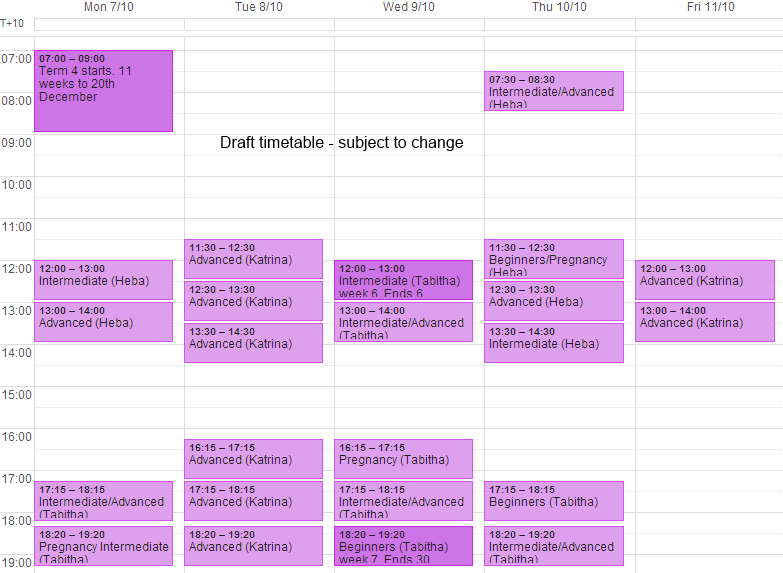
Draft timetable Term 4 - Sydney CBD

pilates timetable


2 Sept 2013 BY Katrina Tarrant POSTED IN Pilates

Pilates and ‘mindful’ movement

Pilates, Yoga and Feldenkrais can really capitalise on the practice of mindfulness

Mindfulness is originally a Buddhist term and is used a lot in clinical psychology for reducing stress, anxiety and depression. It is all about being in the present moment and allowing your thoughts, feelings and sensations to just be, without judgement. It is about being aware of the you without evaluation. 

Exercise disciplines such as Pilates, Yoga and Feldenkrais can really capitalise on the practice of mindfulness to enhance practice and results. Making contact with what is as you move, breathe or relax can better help you learn the movement, improve your strength, mobility and reduce pain levels. 

Mindful movement can be done through becoming aware of how you move. This can be done in the most simplest of ways, including:

Visualising the movement with closed eyes as you move

Visual representations and cues for your movement

Focusing on the sensations associated with the movement, such as muscles contracting or shortening, lengthening, stretching, or bones feeling heavy

Focusing on symmetry of movement across your body

Smooth and controlled movement

Mindfulness in movement allows for improved motor learning, or skill acquisition. By definition, human learning is any permanent change in behaviour, knowledge, skill or ability that cannot be ascribed to development or inherited growths. Motor learning is the process of learning a movement – from acquisition to practice. It requires the brain to ‘write’ motor programs amongst your nerve pathways using information about the movement, knowledge and experience. This includes the correct muscles to be used, the correct nerve pathways talking to the muscles, movement sequencing, timing and automation. To be more aware of your movement, you can ‘write’ your motor programs better to develop new movement habits and for them occur automatically. This is just like the preparatory activation of the deep pelvic stabilising muscles before your body moves to protect the spine and pelvis. Through thoughtful practice, your deep muscles can do just this! 

Pain management for those with all sorts of pain associated with movement or postures benefit hugely from thoughtful movement. Pain is ‘wired up’ in the brain as ‘pain movies” (as we’ve spoken about several times in our ‘Pain Tales’ posts). We know that subjective feelings about movement and pain can ‘fire off’ the pain experience in someone with persistent pain. Remembering that particular movements have always been painful, have caused pain before, evaluating movement experiences as ‘good’, ‘bad’ or fear that movement or exercise will make the pain worse – this can all get in the way of beating the pain cycle. By minimising these subjective describing words and judgements when exercising mindfully, it is often possible to move through the pain. This can establish new nerve pathways, movements that are no longer as threatening, less pain with activity and a potential breaking down of the pain cycle. 

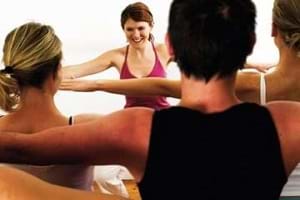
At The Fix Program, as physiotherapists, we truly believe and place a huge emphasis on mindful movement. Within our classes, we use a mix of strategies to bring you ‘into the moment’ with your exercise, to forget what’s going on outside the studio, become more aware of your own movement patterns and to make change. And we see wonderful results in doing this.

Why not try practicing mindfulness in everything you do? From your exercise routines, to your work and home life. Live in the moment without judgemental thoughts getting in the way.


30 Aug 2013 BY Katrina Tarrant POSTED IN Back Pain

Pain tales – How relaxation brings pain relief

We’ve discussed how the brain can produce a pain experience when it perceives a threat. Threatening inputs, memories and circumstances can also lead to a stress response, which many in turn worsen your pain. Today we’ll talk about how relaxation brings pain relief – but first, what is stress?

tiger

We’ve all heard the expression ‘fight or flight’. This is how the body has evolved to respond to any threatening situation. In times of stress the body uses a hormone called cortisol. Cortisol turns on process we need for survival and switches off process that are not needed for survival. What do you need if a tiger is chasing you? Muscles – to fight or run away and your brain – for quick thinking! What don’t you need if a tiger is chasing you? Reproduction and digestion. Healing can probably also be put on hold.

So as you can see, this stress response is great in an emergency, but what if that tiger follows you around for a year and you’re stressed all the time? Prolonged elevated cortisol levels have been linked to depression, mood swings, memory changes, poor healing, weight gain and immune problems.

So you can see that if your pain is making you stressed, your stress can make things much worse, including the pain itself.

On the flip side, when you’re relaxed and feeling good, your body produces ‘happy hormones’ such as such as opioids and serotonin that block danger messages travelling up the nerves to your brain. We know that they’re 60 times more powerful than the strongest pain-relieving drug on the market. A lovely ‘soup’ for your brain and nerves to float around in.

So how do you de-stress. For a start, stop worrying about the pain. This makes a lot of sense now you know that worrying about your pain is scientifically proven to make it worse. Yoga, relaxation, meditation and breathing techniques have also been proven to reduce the level of circulating stress hormones and increase your level of happy hormones. Try going for a walk, listening to relaxing music, or just clearing your mind for twenty minutes every day.

Another technique is to set aside ‘worry time’. Rather than worrying about things constantly (and keeping your Cortisol levels elevated) make a specific time every week when you think about your worries. If a worry enters your head at another time, like when you’re trying to fall asleep, set it aside for your ‘worry time’.

So remember - relax and feel less pain.


30 Aug 2013 BY Katrina Tarrant POSTED IN Exercise

Set your exercise goals and go for it!

Tabitha shares her personal feelings about taking on the running challenge

Until four months ago, I could not have conceived of calling myself ‘a runner’ – I was sure that it was something obviously, even inherently impossible. I’m not sure what made me so sure, since I’ve led a fairly active life and have exercised in many different ways. Yet for some reason the thought of jogging for 30mins straight seemed insurmountably difficult.

Somehow, the idea of learning to jog began circulating amongst my friends and family. Many were total beginners, and enthusiasm occurred across the whole spectrum of age, shape and size. I was intrigued, and discovered a quiet envy for the joy and achievement that runners reported. I was also looking for a way to increase my overall fitness to combat the pain I feel from old sporting injuries – the relationship between increased fitness and decreased pain experience has been a valuable lesson I have learned from The Fix Program.

Soon afterwards, a friend recommended the book Running like a Girl by Alexandra Heminsley. Initially it reads like a runner’s memoir, telling the tale of Heminsley’s own journey in becoming a runner – from the first agonizing jog to her marathon peaks and troughs. She demonstrates that while running requires some commitment, its rewards are many, particularly for your self-confidence. She encourages the reader to tie up their laces, give it a go, and keep running regularly. Ideal for novice runners, this book’s heartfelt, conversational and hilarious style guides you through your concerns and assures you that they are both common and unfounded. It also includes very helpful practical pointers about running, debunking ineffective practices and thoughts that beginners (such as myself!) could fall into and offering positive advice in its place. I took her advice and resolved to start running.

To help me along the way was the popular smart phone app called Couch 2 5K. This isa complete jogging program that aims to turn a beginner into a 5km runner – about 30mins of continuous running – in just nine weeks. The app directs you through audio cues, easily heard over music, to alternate between walking and jogging in prescribed intervals over half an hour. The lengths of the jogging intervals are slowly increased throughout the sessions, and the change felt gradual and entirely manageable to me. This handy, practical tool uses the principles of goal setting and pacing (as discussed in many Fix Program classes). With this you can slowly and steadily achieve your jogging goals while giving the body time to recuperate between sessions. This helps in avoiding the boom-bust cycle of yoyo exercisers and the associated injuries and discouragement I had both experienced and been warned about in Heminsley’s book. By the end of nine weeks I had read the book twice and could jog without stopping for a full half hour – I was completely transformed, both mentally and physically, and feel fitter and more confident than my pessimistic past self would have believed possible.

Maybe you too can become a runner?


29 Aug 2013 BY Katrina Tarrant POSTED IN Pregnancy

Why is relaxation essential in pregnancy and as a new mother?

Make time for yourself

In pregnancy and after the arrival of your baby, even a short relaxation time each day will make a big difference to your stress levels and feelings of tiredness that can seem overwhelming. This time spent relaxing can also increase your ability to cope and aid in a better overall hea_l_th and mental wellbeing. If you are still to give birth, these techniques can be used within labour to aid in pain relief.

What makes me stressed?

We’ve all heard the expression ‘fight or flight’. This is how the body has evolved to respond to any threatening situation. In times of stress the body uses a hormone called cortisol. Cortisol turns on processes we need for survival and switches off processes that are not needed for survival. This is great in an emergency, but if you are stressed all of the time, prolonged elevated cortisol levels have been linked to depression, mood swings, memory changes, poor healing, weight gain and immune problems.

On the flip side, when you’re relaxed and feeling good, your body produces ‘happy hormones’ such as opioids and serotonin.

How do I de-stress?

For a start, try to stop worrying. Yoga, relaxation, meditation and breathing techniques have also been proven to reduce the level of circulating stress hormones and increase your level of happy hormones.

Try going for a walk, listening to relaxing music, or just clearing your mind for twenty minutes every day.

Try to set aside ‘worry time’. Rather than worrying about things constantly (and keeping your cortisol levels elevated), make a specific time every week when you think about your worries.

Try this relaxation technique when lying down or sitting comfortably. Close your eyes and focus on your deep breathing. Focus on the cool air as you breathe in through your nose and the warm air and you breathe out through your mouth. Focus on one body part at a time starting from your head all the way to your toes imagining all your muscles releasing and feeling heavy.

Try to take time to practice the Buddhist practice of mindfulness throughout your day. Even a minute here and there to become mindful of your breath, the comings and goings of your body sensations, tensions and your surroundings can help to de-clutter your brain and provide energy and calmness.


Fix News