The Fix Program Blog

18 Apr 2026 BY Katrina Tarrant POSTED IN Exercise, Physiotherapy

IT Band Syndrome: why your knee hurts and your glutes are to blame
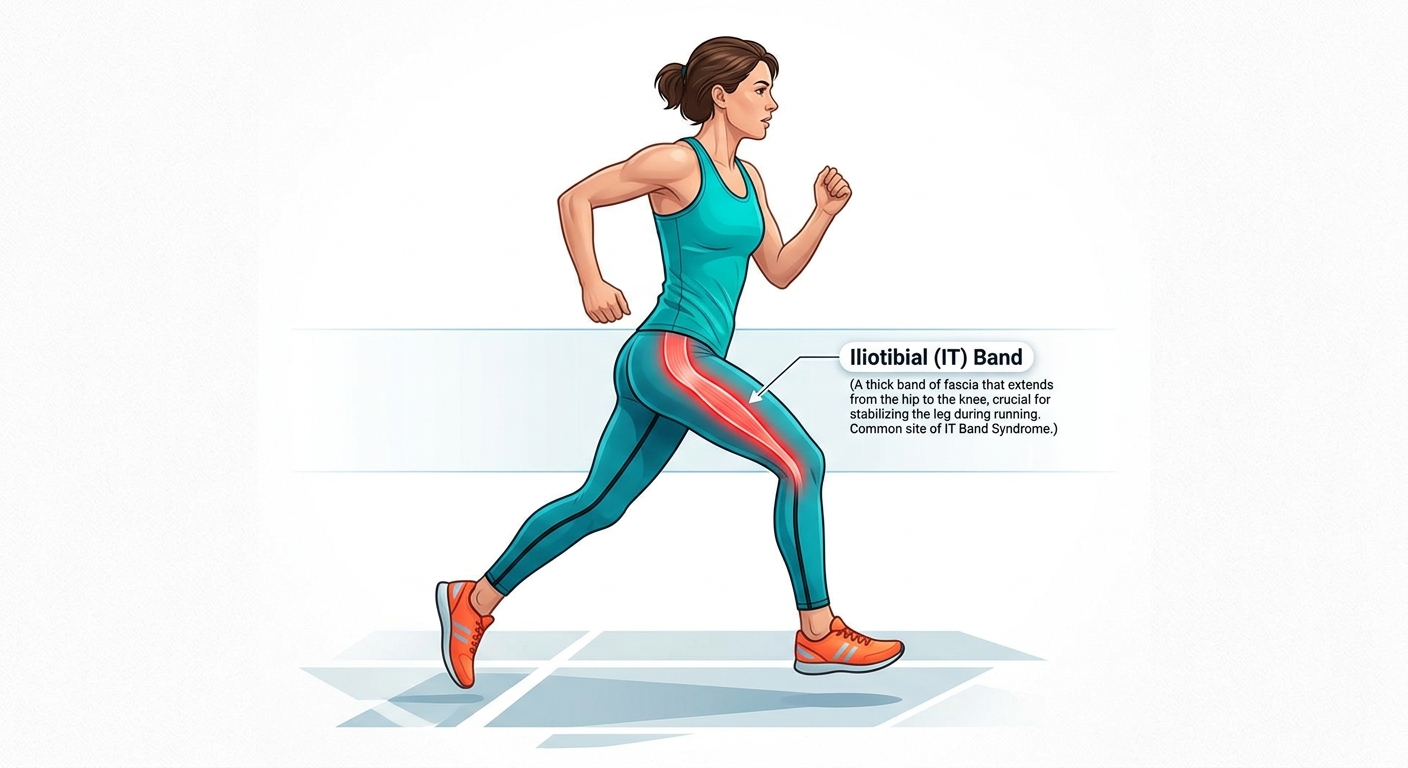
IT Band Syndrome: lateral knee pain from weak glutes

The side-of-knee pain that stops runners in their tracks

You’ve felt it — that sharp ache on the outside of your knee, usually striking mid-run when fatigue sets in. It might start as an annoyance, but push through it and it becomes unbearable. Welcome to IT band syndrome, the bane of runners everywhere.

The iliotibial band (IT band) is a thick strip of fascia running from your hip to your knee along the outside of your thigh. It’s not a muscle — it can’t be stretched like one. When it gets irritated, usually from rubbing against the bony bump on the outside of your knee, the pain is unmistakable.

Here’s the part most runners miss: IT band syndrome is rarely a knee problem. It’s almost always a hip and glute problem showing up at your knee.


Why your IT band screams

When your gluteus medius and hip abductors are weak, your thigh bone rotates inward with each step. This tightens the IT band and causes it to rub against the lateral femoral condyle — that bony knob on the outside of your knee. Rubbing creates friction. Friction creates inflammation. Inflammation creates pain.

The usual recipe for disaster:

Notice what’s missing from that list? Actual IT band tightness. Blaming a tight IT band is like blaming the victim. The band is tight because something above it isn’t doing its job.


The warning signs

IT band pain has a specific signature:

  • Pain on the outside of the knee, not the front or inside
  • Pain that starts 10–15 minutes into a run and worsens until you stop
  • Pain going down stairs (worse than going up)
  • Pain when you press on that bony spot on the outside of your knee
  • No swelling, but definite tenderness

If your pain is on the front of the knee beneath the kneecap, that’s runner’s knee — different problem. If it’s on the inside, that’s medial knee pain — different again. IT band pain is distinctly lateral (outside).


Fixing IT band syndrome: strength and control

Stretching your IT band won’t help. It’s fascia, not muscle, and research shows it barely stretches at all. The fix is strengthening the muscles that control your hip and thigh — namely your gluteus medius and hip abductors — so your IT band stops getting yanked tight with every stride.

Here are the three most effective exercises for IT band syndrome recovery and prevention.


Clam Shell — Gluteus Medius Activation

Targets: Gluteus medius, gluteus minimus, deep hip rotators

The clam is your foundational move. It looks simple, but done correctly, it fires up the muscles that should be stabilising your pelvis with every step.
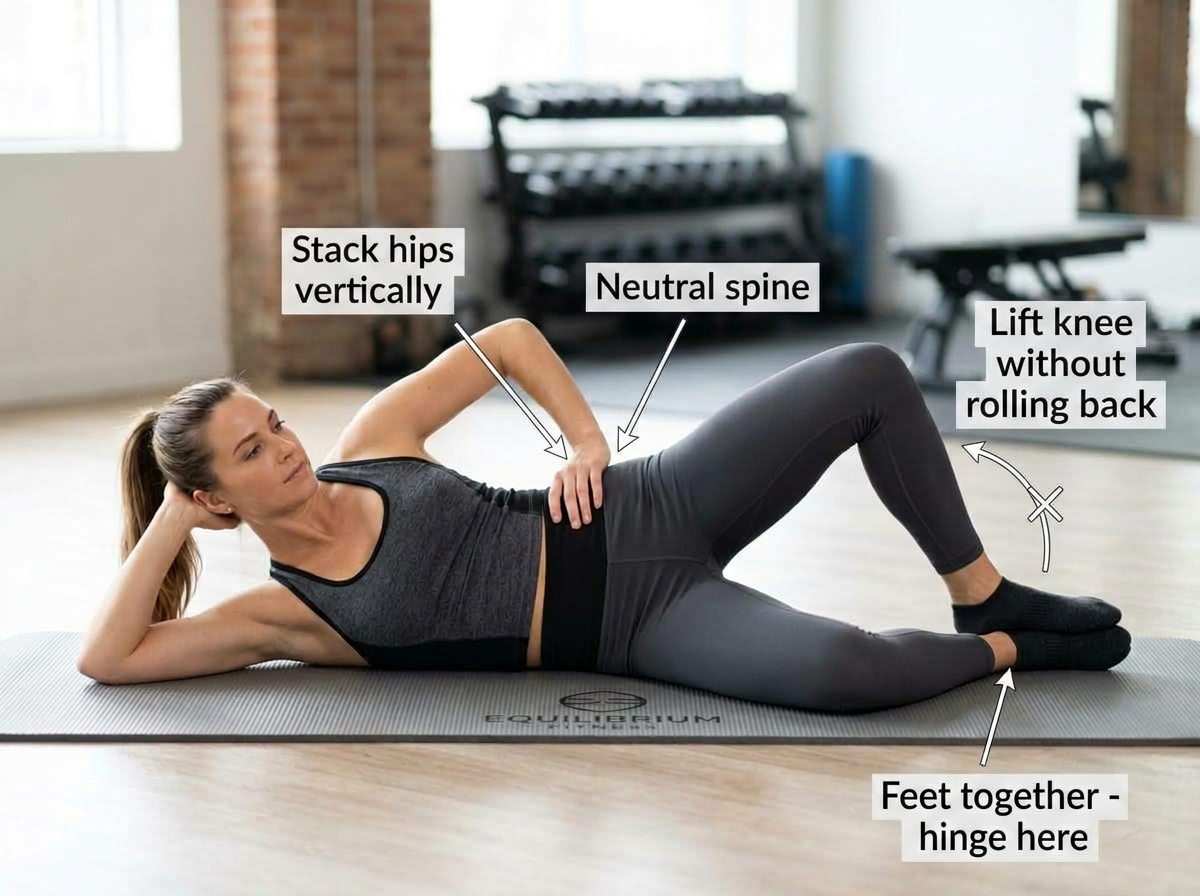
Clam shell exercise for IT band syndrome - side lying hip abduction with form cues

Step-by-step instructions:

  1. Lie on your side on a comfortable mat or carpet
  2. Bend your knees to approximately 45 degrees, stacking them on top of each other
  3. Keep your feet together — they act as a hinge throughout the movement
  4. Rest your head on your bottom arm or prop your head up with your hand
  5. Place your top hand on your top hip to feel the muscle working — this is your feedback
  6. The movement: Keeping your feet touching, slowly lift your top knee upward like a clamshell opening
  7. Lift as high as you can WITHOUT letting your hips roll backward — this is the critical cue
  8. Your pelvis should stay perfectly still; only your knee moves
  9. Hold for 2–3 seconds at the top, squeezing your side glute hard
  10. Lower slowly with control, resisting gravity on the way down

Common mistakes to avoid:

  • Don’t let your top hip roll back — if it does, you’ve lost the target muscle
  • Don’t rush — slow movement is harder and more effective
  • Don’t let your feet separate — they must stay touching
  • Don’t hold your breath — exhale as you lift, inhale as you lower

Do: 3 sets of 15 repetitions per side

Frequency: Daily during recovery; 3–4 times per week for prevention

Progression: Add a resistance band just above your knees — this increases the challenge significantly and better mimics running demands


Side-Lying Hip Abduction — Building Strength
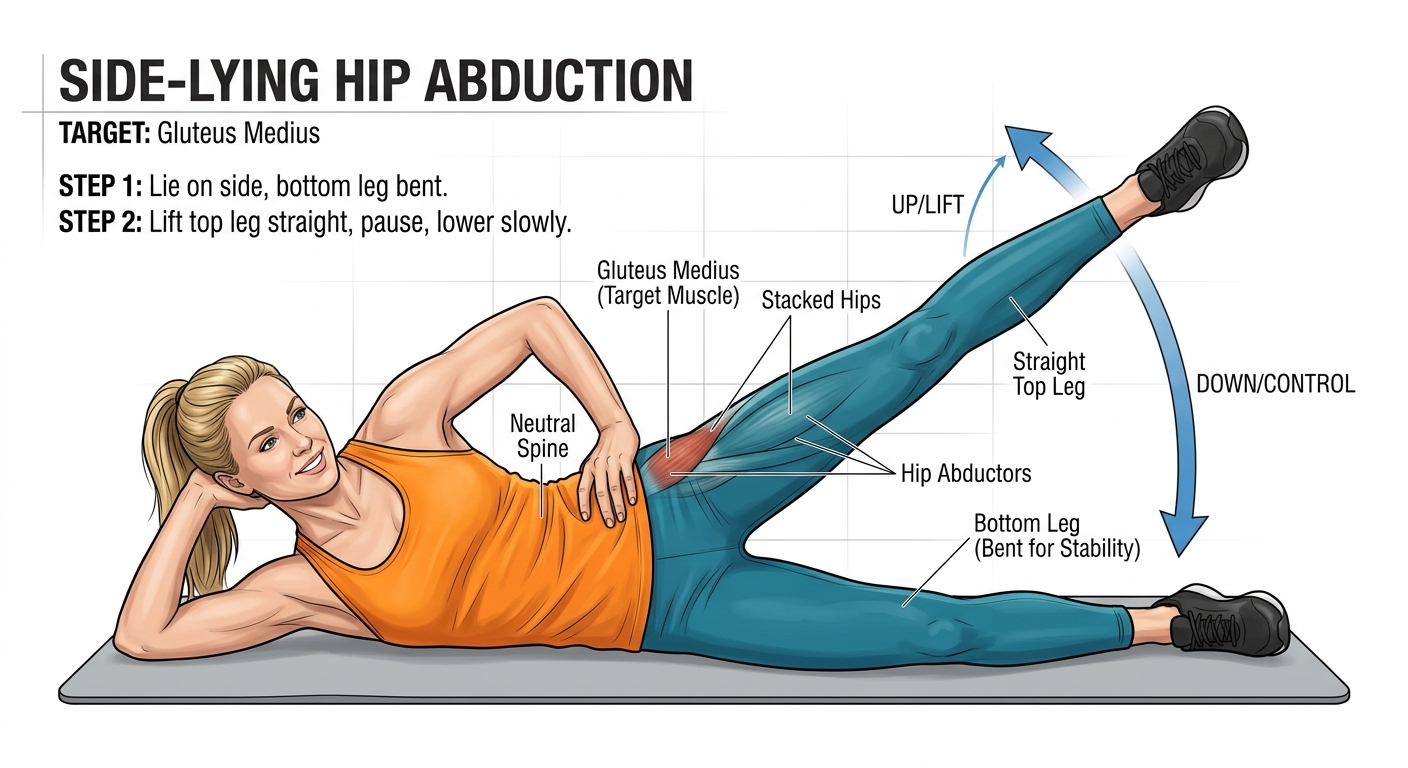
Side-lying hip abduction for gluteus medius and TFL strengthening

Targets: Gluteus medius, tensor fasciae latae (TFL), hip abductors

Once you’ve activated your glutes with clams, it’s time to load them up. This exercise builds the strength that keeps your knee tracking properly when you run.

Step-by-step instructions:

  1. Lie on your side on a comfortable surface, body in a straight line from head to toe
  2. Stack your hips directly on top of each other — don’t let your top hip roll forward or back
  3. Keep your bottom leg bent at 90 degrees for stability
  4. Extend your top leg straight out in line with your body, toes pointing slightly downward toward the floor
  5. Rest your head on your bottom arm
  6. Place your top hand on the floor in front of your chest for light balance support, or rest it on your top hip
  7. The movement: Keeping your body perfectly still and your leg straight, lift your top leg straight up toward the ceiling
  8. Lift to approximately 30–45 degrees — no higher, or your hips will cheat by rolling
  9. Your top hip bone should stay pointing directly forward, not rolling back with the leg
  10. Lower slowly with control, tapping your toe gently on the floor before the next rep

Common mistakes to avoid:

  • Don’t let your leg drift forward — keep it in line with your body
  • Don’t roll your top hip backward to lift higher — quality over quantity
  • Don’t point your toes up toward the ceiling — keep them slightly down
  • Don’t lift above 45 degrees — that’s when other muscles take over

Do: 3 sets of 12–15 repetitions per side

Frequency: Daily during recovery; 3–4 times per week for maintenance

Progression: Add a light ankle weight (1–2 kilograms) or resistance band around your ankles once bodyweight becomes too easy


Single-Leg Romanian Deadlift — Functional Control
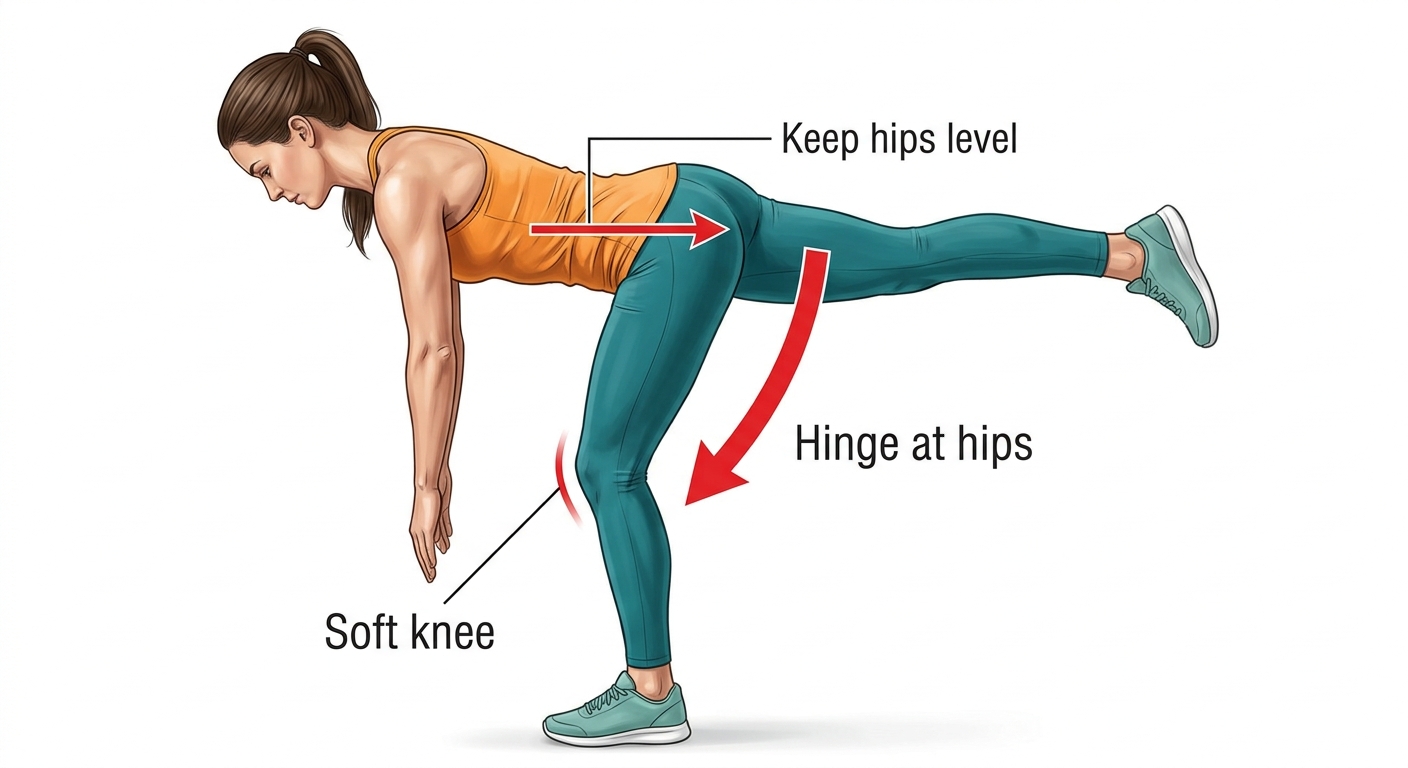
Single-leg Romanian deadlift for functional hip stability and glute strength

Targets: Gluteus maximus, gluteus medius, hamstrings, core stability

This is the bridge between rehab exercises and running. It teaches your hips to stabilise your entire leg while your body moves — exactly what happens when you run.

Step-by-step instructions:

  1. Stand tall with your feet hip-width apart, holding a light dumbbell or kettlebell in your right hand (or no weight to start)
  2. Shift your weight onto your left foot, keeping a soft bend in your left knee — never lock it completely straight
  3. Lift your right foot slightly off the floor, just clearing the ground
  4. The movement: Hinge forward at your hips, sending your right leg straight back behind you
  5. Keep your spine neutral with a slight natural curve in your lower back — don’t round or arch excessively
  6. Lower your torso until you feel a stretch in your left hamstring, approximately parallel to the floor
  7. Your right leg extends behind you as a counterbalance, creating a T-shape with your body
  8. Your hips should stay level — imagine a glass of water balanced on your lower back that shouldn’t spill
  9. Return: Squeeze your left glute hard and drive your hips forward to return to standing
  10. Complete all reps on one side before switching

Common mistakes to avoid:

  • Don’t let your hips open up toward the ceiling — keep them square to the floor
  • Don’t round your back — keep your spine long and neutral throughout
  • Don’t lock your standing knee — keep it softly bent
  • Don’t let your standing foot turn out — keep it pointing forward

Do: 3 sets of 8–10 repetitions per side

Frequency: 3–4 times per week (this is a strength exercise, not daily)

Progression: Increase weight gradually, or add a balance challenge by standing on a cushion or BOSU ball


The bottom line

IT band syndrome isn’t a life sentence, but ignoring it is. The pain will only worsen until you address the root cause — weak hip stabilisers that let your thigh rotate and yank that band tight.

The exercises above aren’t magic. They work because they rebuild the strength and control your running stride demands. Do them consistently for 4–6 weeks and your knee will thank you.

For more on building hip stability through Pilates, see Pilates and Hip Stability. If you’re dealing with knee pain more broadly, Can Pilates help with Knee Pain? covers the fundamentals.

And once you’re pain-free? Don’t stop. These exercises are your insurance policy against recurrence. Ten minutes, three times per week, and you can keep running without that dreaded lateral knee pain.

Your IT band isn’t the enemy. Weak hips are. Strengthen them, and your band will stop screaming.

11 Apr 2026 BY Katrina Tarrant POSTED IN Exercise, Physiotherapy

Your hip flexors are stealing your stride

Your hip flexors are stealing your stride

The hidden cause of your runner’s knee, back pain, and sluggish times

You’ve heard of tight hamstrings. Tight calves. But when was the last time you thought about your hip flexors? If you’re like most runners, probably never — until they start causing problems.

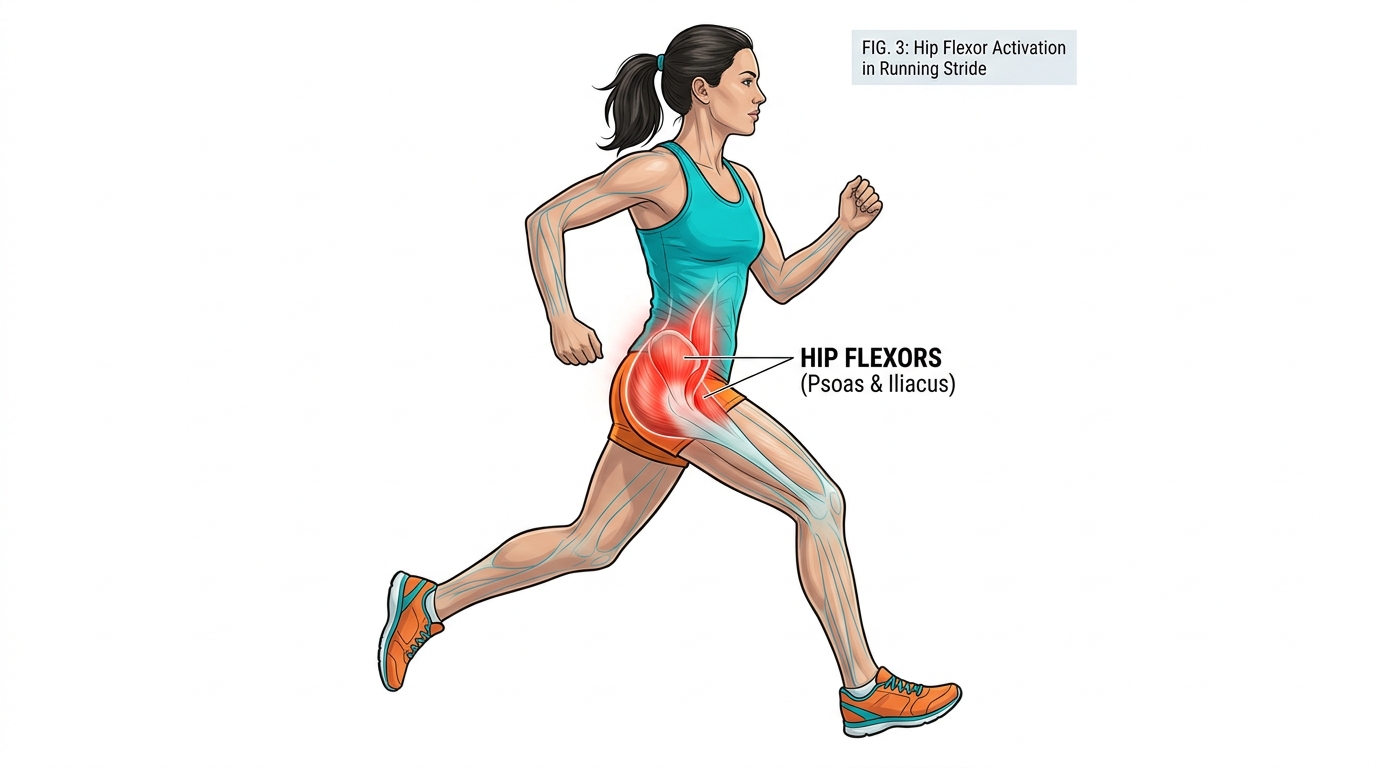
Your hip flexors are a group of muscles at the front of your hips that lift your knee toward your chest. Every running stride uses them. Yet most runners stretch their hamstrings religiously while their hip flexors tighten into rocks, quietly sabotaging performance and inviting injury.


Why hip flexors matter for runners

When your hip flexors are tight, they pull your pelvis into an anterior tilt — imagine spilling water out of the front of a bucket. This creates a cascade of problems:

Tight hip flexors don’t hurt in the way a calf cramp does. Instead, they show up as that nagging lower back ache after hills, the stiff feeling when you stand up from your desk, or the sense that your stride just isn’t opening up the way it used to.


The sitting problem

Here’s the modern curse: we sit. A lot. And sitting puts your hip flexors in a shortened position for hours. Your brain learns this as “normal.” When you stand up, those muscles resist lengthening. They adaptively shorten.

Runners often think they’re exempt because they exercise. But 30–60 minutes of running doesn’t undo 8–10 hours of sitting. Your hips don’t care about your weekly mileage if the rest of your day is chair-bound.

The result? You start runs feeling stiff. Your first kilometre feels like your hips are stuck in second gear. You might unconsciously shorten your stride to avoid the discomfort of full hip extension.


The signs your hip flexors are tight

Not sure if this applies to you? Try this quick scan:

  • Standing test: Stand with feet together and notice if the curve in your lower back is excessive (hands should slide easily behind your back)
  • Thomas test: Lie on your back at the edge of a bed, hug one knee to your chest. Does the other thigh lift off the bed? If yes, tight hip flexors
  • Walking test: When you walk, do your feet feel like they land too far in front of you rather than under your hips?
  • Running test: Do you feel restricted at the back of your stride, like you can’t let your leg trail fully behind you?

Releasing your hip flexors: the stretch routine

The fix isn’t complicated, but it requires consistency. Here are the most effective hip flexor releases for runners.


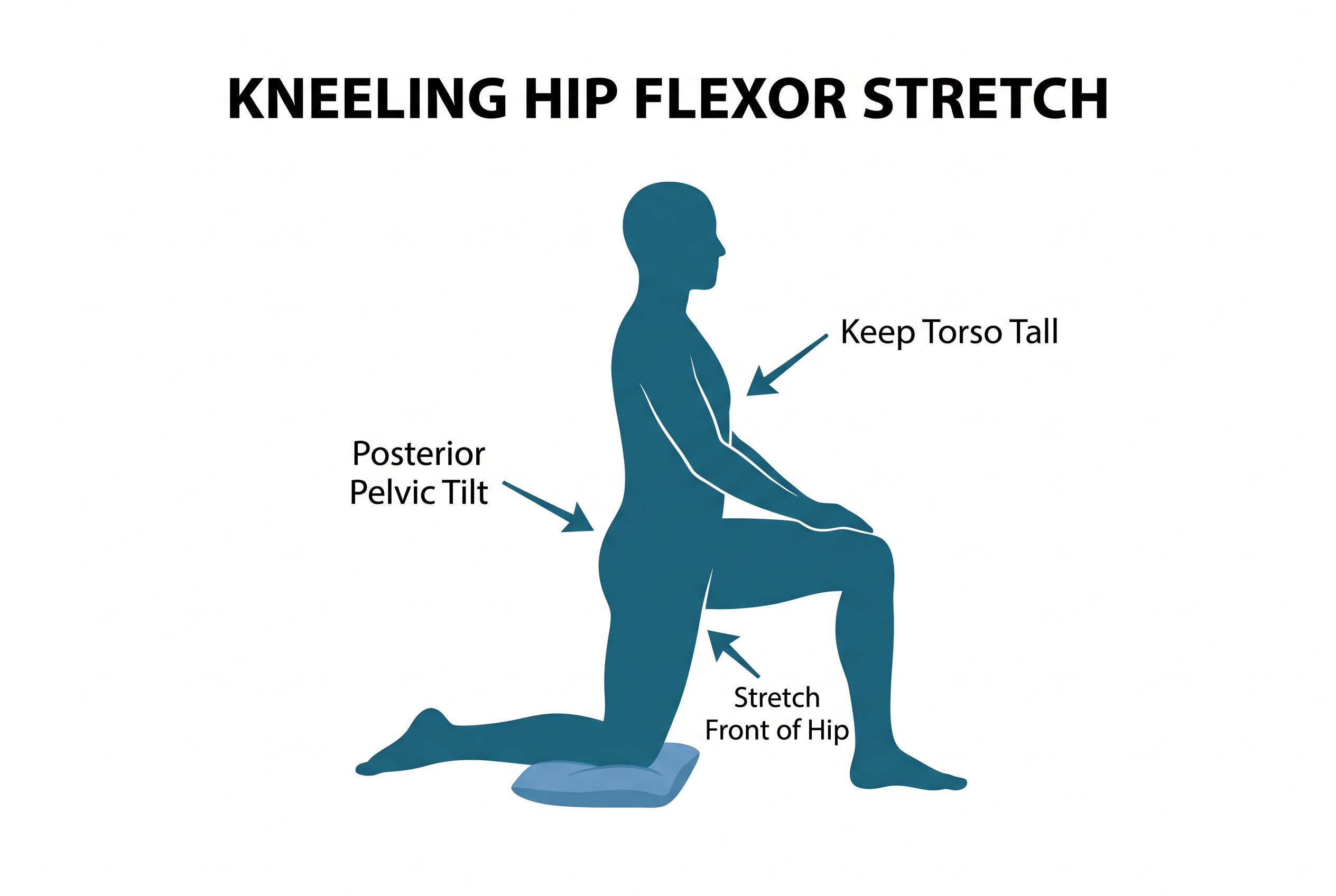
Kneeling Hip Flexor Stretch — The Foundation

Kneeling hip flexor stretch showing half-kneeling lunge position with posterior pelvic tilt

Targets: Psoas major, iliacus, rectus femoris

This is your bread and butter stretch. Done right, it targets the deep hip flexor muscles that connect your spine to your leg.

Step-by-step instructions:

  1. Start in a half-kneeling position on a comfortable surface (use a cushion under your back knee if needed)
  2. Place your right foot flat on the ground in front of you, knee bent at 90 degrees
  3. Keep your left knee on the ground behind you
  4. Critical step: Tuck your tailbone slightly by drawing your pubic bone toward your belly button (posterior pelvic tilt) — this flattens your lower back
  5. Place both hands on your front thigh for balance
  6. Gently push your hips forward until you feel a stretch in the front of your left hip
  7. You should feel the stretch in the thigh of your back leg, not in your lower back
  8. Keep your torso tall and shoulders stacked over your hips
  9. Breathe deeply and hold
  10. Switch sides and repeat

Common mistakes to avoid:

  • Don’t arch your lower back — this means you haven’t tucked your pelvis enough
  • Don’t let your front knee travel past your toes — keep shin vertical
  • Don’t lean forward — stay upright through your torso

Hold for: 45–60 seconds per side

Frequency: Daily, especially after running and sitting

Progression: Raise the arm on the same side as your back leg, reaching up and slightly back to deepen the stretch


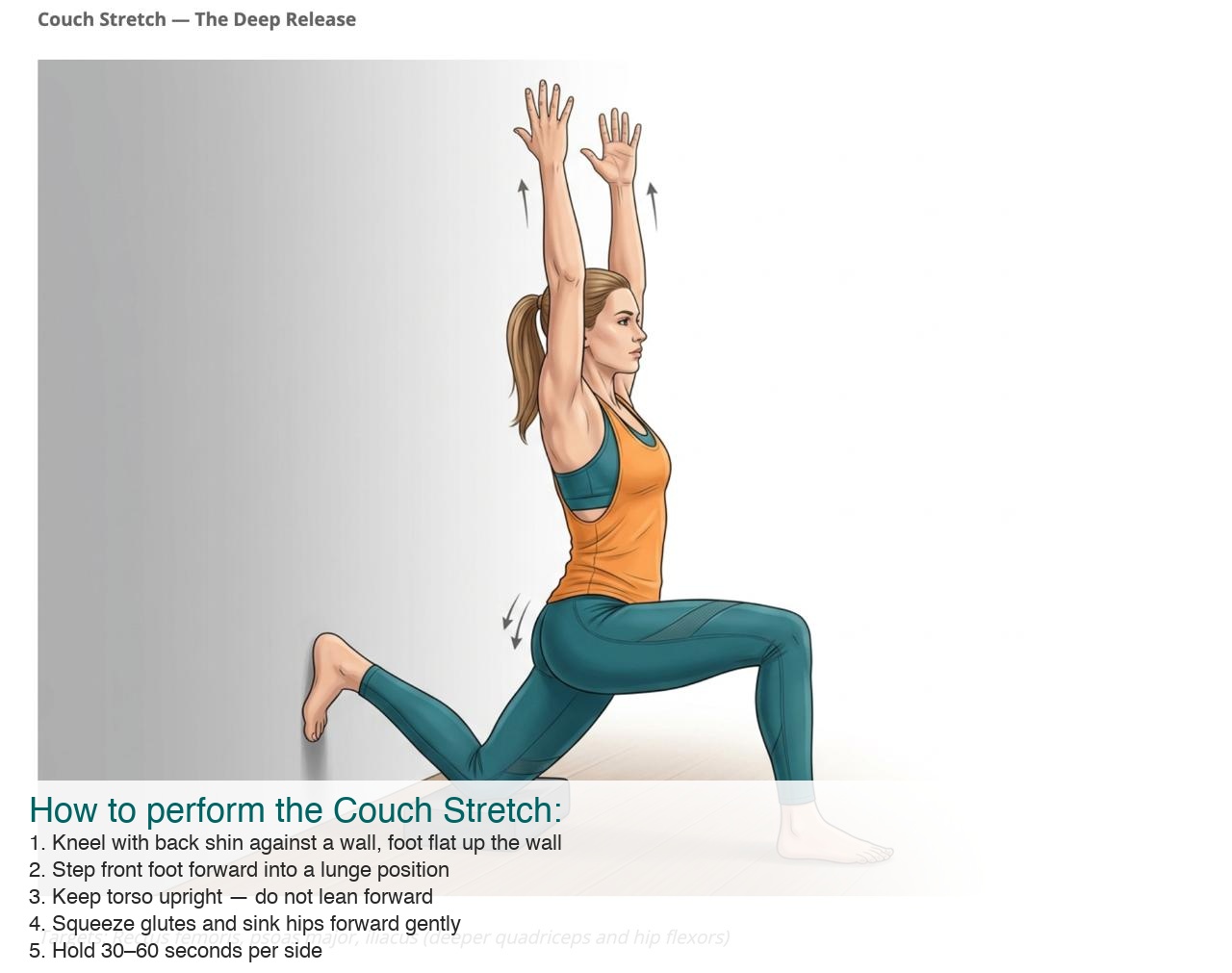
Couch Stretch — The Deep Release

Couch stretch showing deep hip flexor and quadriceps stretch against wall

Targets: Rectus femoris, psoas major, iliacus (deeper quadriceps and hip flexors)

Named for the fact that you can do it against the back of a couch, this stretch takes the kneeling position deeper. It adds a quadriceps component that the basic hip flexor stretch misses.

Step-by-step instructions:

  1. Place a cushion or yoga mat on the floor near a wall or couch
  2. Kneel facing away from the wall with your back knee on the cushion
  3. Bring your back knee right up against the wall, tucking it into the corner where the wall meets the floor
  4. Position the top of your back foot against the wall (shoe lace side facing the wall)
  5. Step your front foot forward into a lunge position, knee bent at 90 degrees
  6. Your front knee should be positioned directly over your front ankle
  7. Critical step: Tuck your tailbone and engage your core to keep your pelvis neutral
  8. Keep your torso vertical — imagine a string pulling the crown of your head toward the ceiling
  9. Gently push your hips toward the wall until you feel a deep stretch in the thigh of your back leg
  10. If you’re doing it right, the intensity tells you you’re in the right place
  11. Switch sides and repeat

Common mistakes to avoid:

  • Don’t let your lower back arch — keep your core engaged
  • Don’t lean forward — the stretch happens through hip extension, not leaning
  • Don’t let your front knee cave inward — keep it tracking over your middle toes

Hold for: 60–90 seconds per side

Frequency: 3–4 times per week, or when feeling particularly tight

Progression: Once comfortable and able to maintain upright posture, raise both arms overhead and reach slightly backward


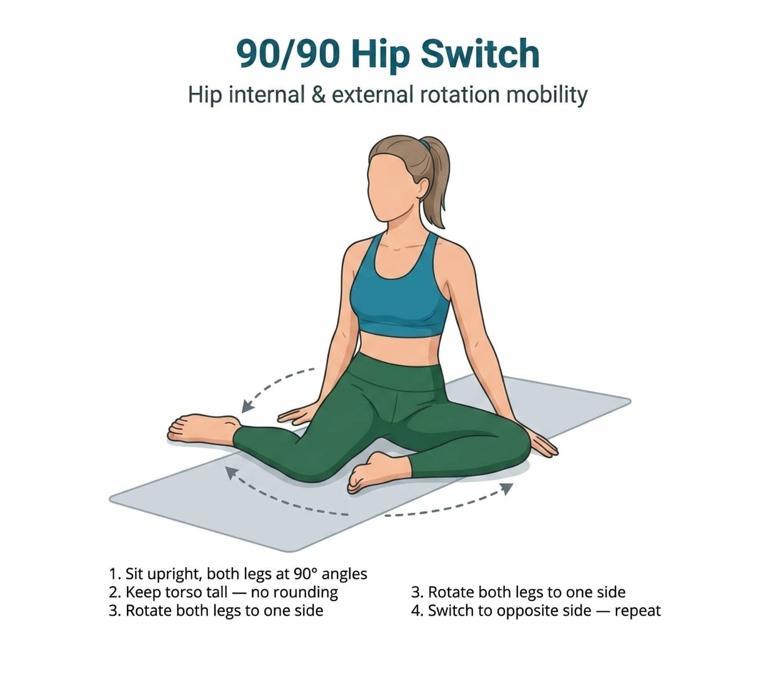
90/90 Hip Switch — Mobility, Not Just Stretching

90/90 hip switch showing dynamic hip rotation mobility exercise

Targets: Hip rotators, gluteus medius, tensor fasciae latae (TFL), hip capsule

Tightness isn’t just about length — it’s about how your hip moves. This dynamic stretch improves rotation and internal/external hip mobility, teaching your hip to move through its full range under control.

Step-by-step instructions:

  1. Sit on the floor with your legs extended in front of you
  2. Bend your right knee and place your right foot on the floor in front of your left hip, knee at 90 degrees
  3. Bend your left knee and place your left leg behind you, also at 90 degrees, with your left foot pointing backward
  4. Both knees should form 90-degree angles — one in front, one behind
  5. Sit tall with your spine extended, hands resting on the floor beside your hips for balance if needed
  6. The movement: Keeping both legs at 90 degrees, rotate your hips and pelvis to switch legs
  7. Bring your left leg forward and your right leg back, both still maintaining 90-degree angles
  8. Your knees are the pivot point — imagine your pelvis rotating around an axis
  9. Move slowly and deliberately with full control — no momentum
  10. Continue alternating sides smoothly

Common mistakes to avoid:

  • Don’t rush — this isn’t a speed exercise
  • Don’t let your knees collapse inward — keep them at true 90 degrees
  • Don’t round your back — stay tall through your spine
  • Don’t let your trailing foot slide out of position

Do: 10 switches per side (20 total rotations)

Frequency: Before running as part of warm-up, or daily for maintenance

Progression: Add a forward fold over each front leg before switching — fold forward, breathe, sit tall, then switch


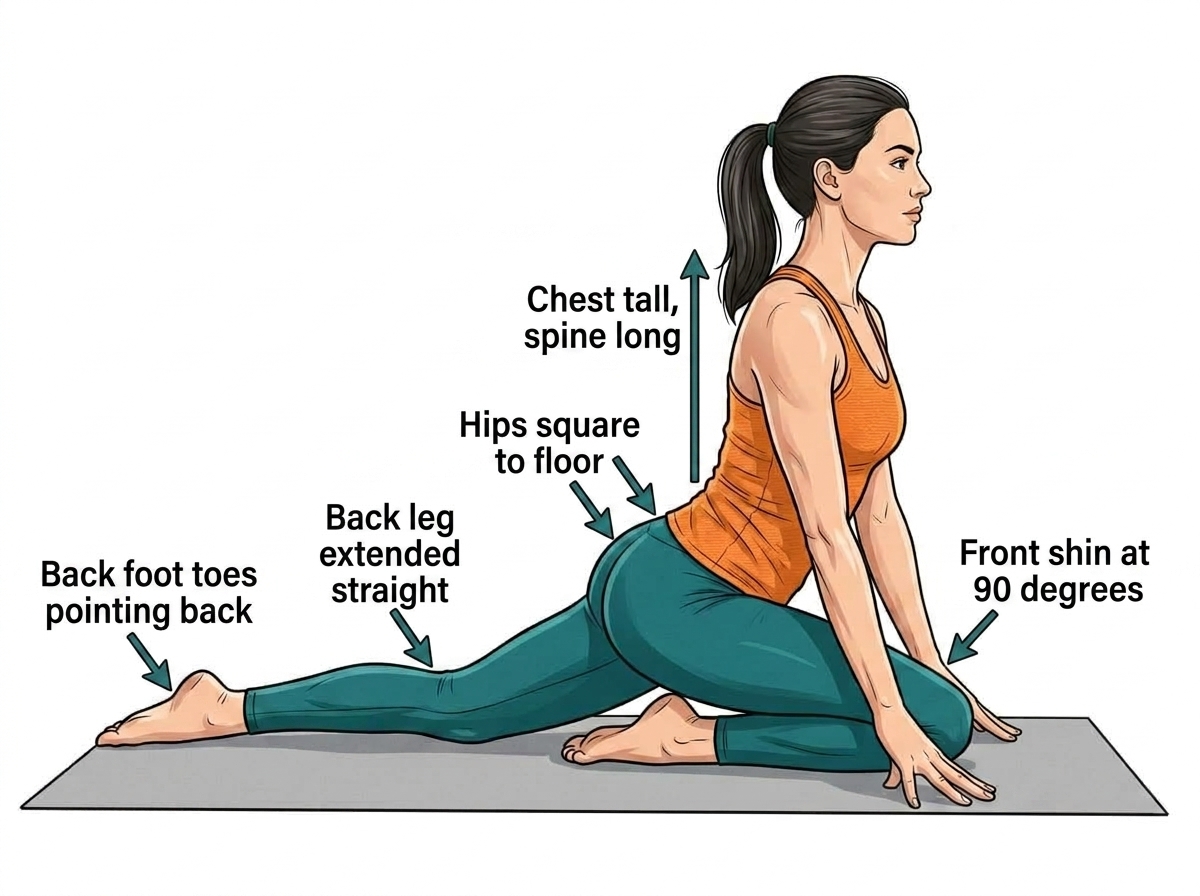
Pigeon Pose (Upright Variation) — The Glute/Hip Flexor Combo

Upright pigeon pose showing glute and hip flexor stretch with form cues

Targets: Gluteus maximus, piriformis, deep hip rotators (front leg); hip flexors (back leg)

Borrowed from yoga but backed by physios, this upright variation targets both the hip flexors of the back leg and the deep glutes of the front leg. It’s efficient and effective for runners who need to open tight hips.

Step-by-step instructions:

  1. Start in a high plank or push-up position on your hands and toes
  2. Bring your right knee forward toward your right wrist
  3. Angle your right shin diagonally across your body toward your left hip/wrist area
  4. The more your shin is perpendicular to your body, the gentler the stretch; the more parallel, the deeper
  5. Extend your left leg straight behind you on the floor
  6. Keep the top of your back foot resting on the floor, toes pointing backward
  7. Square your hips: Gently draw your right hip back and left hip forward so both hip bones face the floor equally
  8. Place your hands on the floor beside your hips and lift your chest tall
  9. Keep your spine extended and shoulders relaxed away from your ears
  10. Gently press your hips toward the floor to deepen the stretch in your right glute
  11. Switch sides and repeat

Common mistakes to avoid:

  • Don’t let your hips roll to one side — keep them square and facing forward
  • Don’t collapse through your lower back — stay lifted through your spine
  • Don’t force the front knee beyond your comfort level — listen to your hip

Hold for: 60–90 seconds per side

Frequency: After running or as part of evening routine

Progression: As flexibility allows, fold forward over your front leg into “sleeping pigeon” variation; use props (cushion, block) under your front hip if needed — better to be supported and square than collapsed and twisted


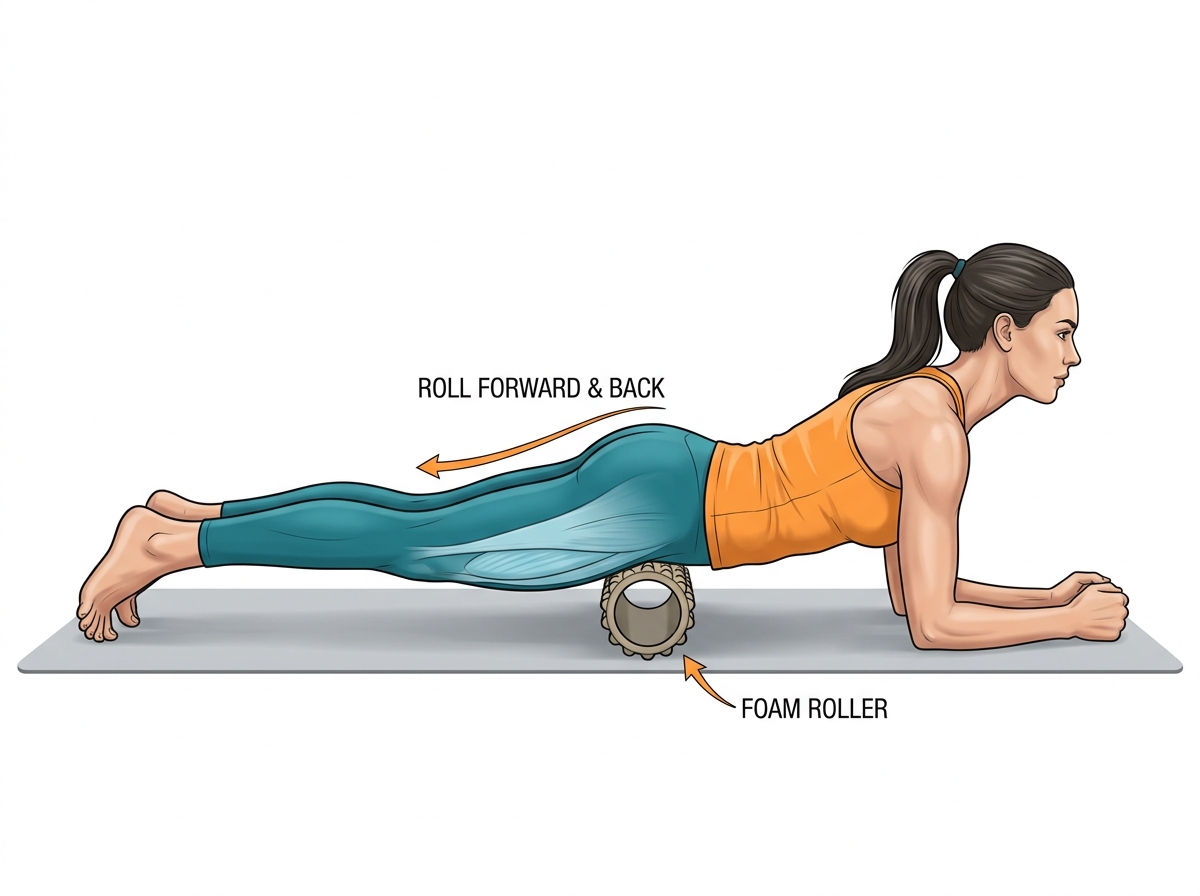
Foam Roller Release — The Self-Massage

Foam roller release for hip flexors and TFL self-massage

Targets: Rectus femoris, vastus lateralis, tensor fasciae latae (TFL), iliotibial band (ITB)

Sometimes stretching isn’t enough — the tissue needs direct pressure to release. This self-myofascial release technique targets the spots your foam roller usually misses.

Step-by-step instructions:

  1. Place a foam roller on the floor in front of you
  2. Get on your hands and knees with your wrists under your shoulders
  3. Lower down onto your forearms, elbows under shoulders, hands together or in fists
  4. Extend both legs straight behind you into a forearm plank position
  5. Position the foam roller under the front of your right hip, just below your hip bone
  6. Your left leg should be relaxed and extended behind you, toes resting on the floor
  7. The movement: Slowly roll forward and backward about 10–15 centimetres
  8. Pause on any tender spots (trigger points) for 20–30 seconds and breathe
  9. Gradually work your way down toward your mid-thigh over 2 minutes
  10. Focus on the area just below your hip bone and slightly to the outside — this targets the iliacus and tensor fasciae latae (TFL), often neglected but commonly tight in runners
  11. Switch sides and repeat

Common mistakes to avoid:

  • Don’t roll directly over the hip bone itself — stay on the soft tissue just below it
  • Don’t rush — spend time on tender spots
  • Don’t hold your breath — breathe into the pressure
  • Don’t go so deep that you feel sharp pain — discomfort is okay, sharp pain is not

Roll for: 2 minutes per side

Frequency: Post-run or daily if chronically tight

Progression: Move to a harder ball (lacrosse ball) for deeper, more targeted pressure


Strengthening: the other half of the equation

Stretching tight hip flexors is only half the battle. You also need to strengthen the muscles that oppose them — your glutes and hamstrings — to hold your pelvis in a neutral position.

From the dead butt syndrome post: glute bridges, single-leg bridges, and hip thrusts. These lock in the gains from your stretching by teaching your body to maintain that open hip position under load.

Strength + flexibility = mobility that lasts.


The bottom line

Your hip flexors are the silent thieves of running performance. They shorten from sitting, tighten from running, and quietly pull your body out of alignment.

You don’t need to become a yoga master. Five minutes of targeted stretching daily — especially after sitting and before running — can open your stride, reduce back pain, and let your glutes do their job.

Pair these stretches with glute activation exercises from dead butt syndrome and hip stability work from Pilates and Hip Stability for complete hip health.

Don’t let your hip flexors steal another kilometre. Give them the attention they deserve.


28 Mar 2026 BY Katrina Tarrant POSTED IN Pilates, Exercise

Dead butt syndrome: when your glutes go on strike

Dead butt syndrome: when your glutes go on strike

And yes, it can happen even if you run every day

You’ve probably heard the phrase “sitting is the new smoking.” Well, your glutes would agree. Dead butt syndrome — or gluteal amnesia, if you want the technical term — is exactly what it sounds like: your butt muscles have literally forgotten how to fire.

Here’s the kicker: this isn’t just a problem for desk workers. Even runners who clock serious kilometres can suffer from it. How? Because running alone doesn’t necessarily wake up sleepy glutes, especially if the rest of your day is spent seated.


What exactly is dead butt syndrome?

Your gluteal muscles — the gluteus maximus, medius and minimus — are meant to be the powerhouse of your lower body. They stabilise your pelvis, propel you forward, and protect your knees and lower back.

When you sit for extended periods (hello, 9-to-5), your glutes are essentially switched off. Hip flexors tighten. Hamstrings take over. And eventually, your brain stops sending signals to activate your glutes altogether — even when you stand up, walk, or run.

The result? Other muscles compensate. Your hamstrings and lower back pick up the slack. Over time, this leads to:


The runner’s paradox

You might be thinking: “I run 40km a week. My glutes must be strong.”

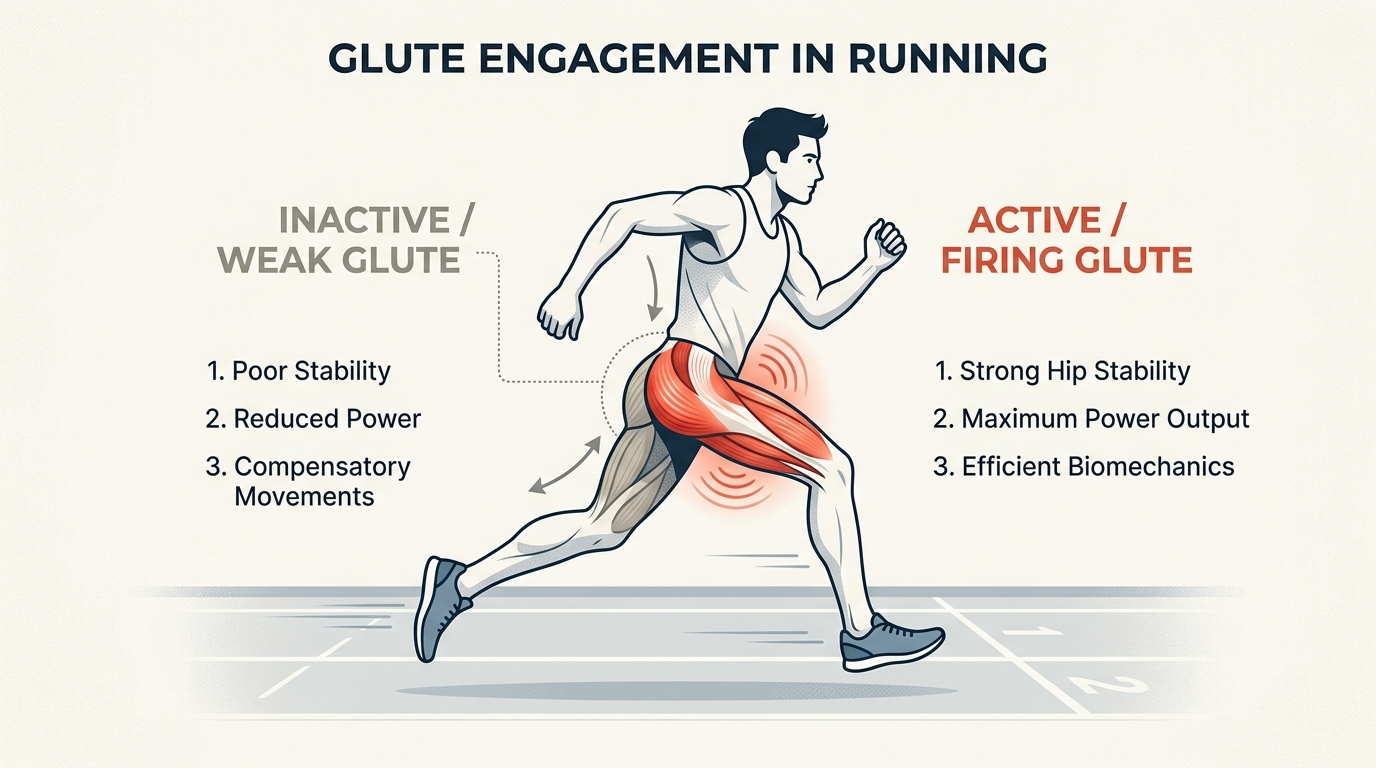
Not necessarily. Running is repetitive and sagittal — you move forward in one plane. Your gluteus medius (hip stabiliser) and gluteus maximus (power generator) need lateral and rotational work to stay fully awake.

If your glutes aren’t firing during your runs, your quads and calves work overtime. You might notice your knees cave inward, your hips drop with each step, or you finish runs with tight calves and a sore back instead of glute fatigue.


The simple test

Want to check if your glutes have checked out?

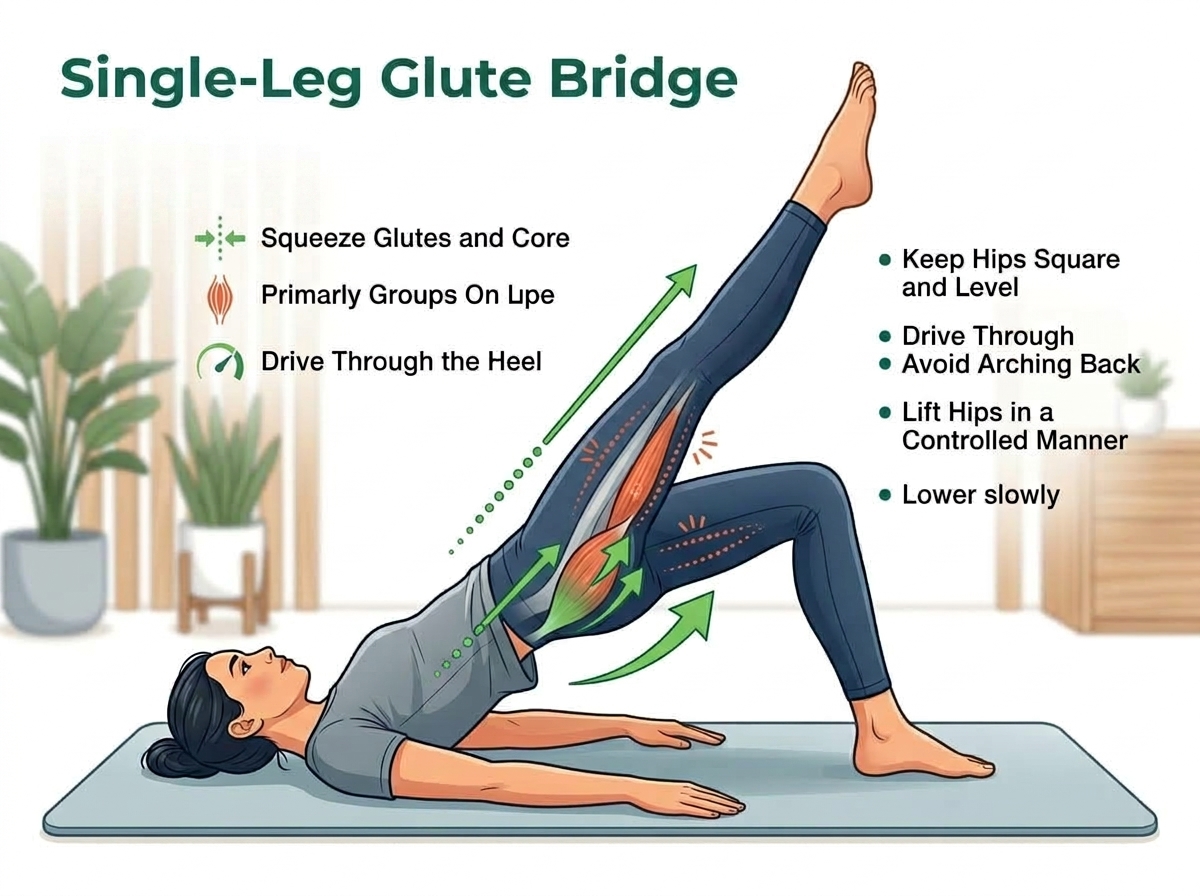
Try a single-leg glute bridge. Lie on your back, knees bent, feet flat. Lift one foot off the ground and push your hips toward the ceiling.

  • If your hamstring cramps immediately, your glutes aren’t participating.
  • If your hips sag or rotate, your gluteus medius is asleep on the job.
  • If you feel it burning in your butt, not the back of your thigh — congratulations, your glutes are awake.

Waking up your glutes: the fix

The good news? Dead butt syndrome is reversible. The bad news? It requires consistency, not just one Pilates class.

Activation with Pilates-style exercises

Before you load up with heavy squats, you need to remind your brain that glutes exist. These Pilates and physio-based exercises wake up the neural pathways. Focus on the squeeze, not the speed.


Clam (Clamshell) — Gluteus Medius Activation

Clam exercise for gluteus medius activation

Lie on your side with knees bent at 45 degrees, heels together. Keeping your feet touching, lift your top knee like a clamshell opening. Do not roll your hips — keep your core engaged and pelvis stable. Hold for 2 seconds at the top.

  • Start with: 3 sets of 12 per side
  • Progression: Add resistance band above knees

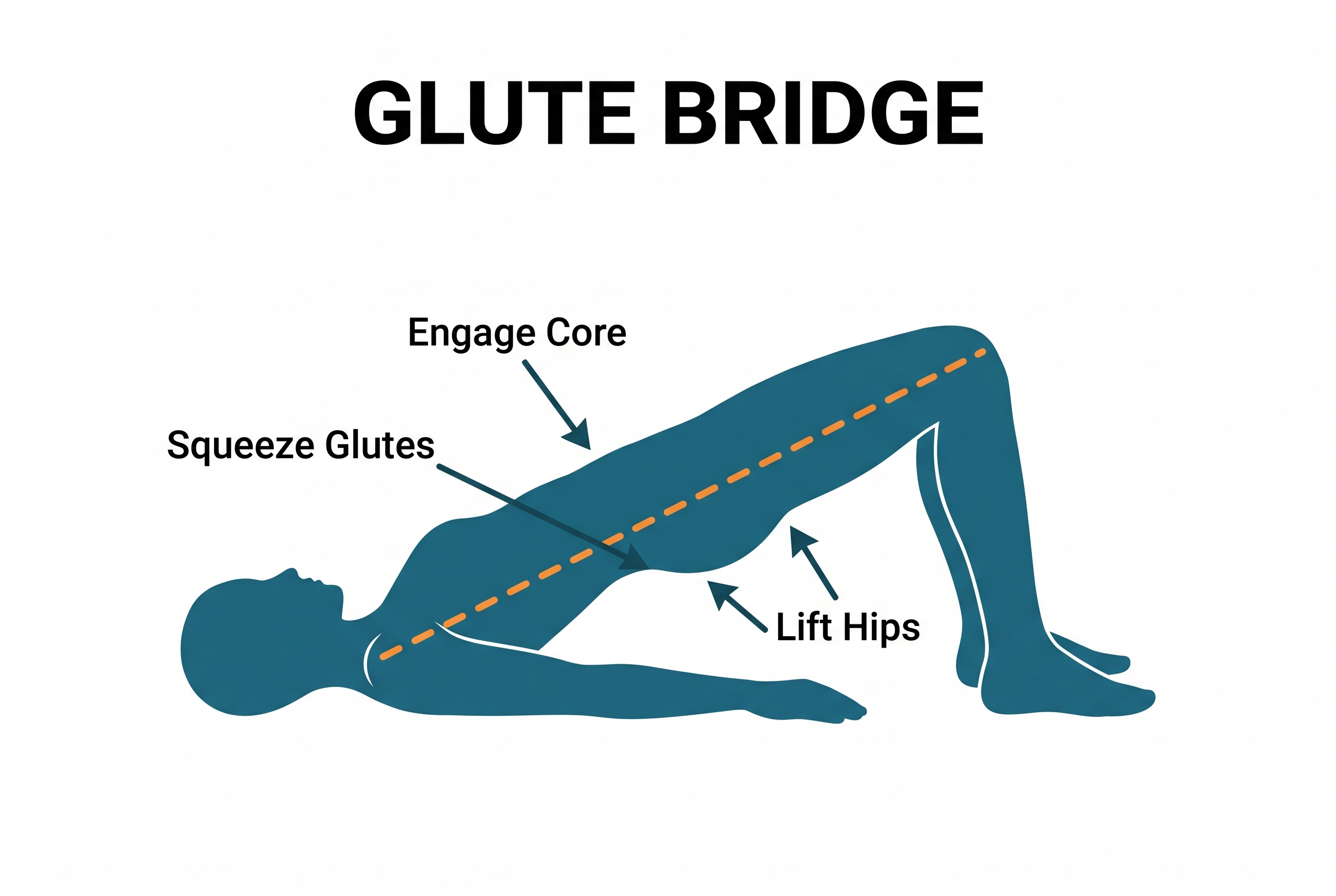
Glute Bridge — Gluteus Maximus Activation

Glute bridge exercise for gluteus maximus activation

Lie on your back, knees bent, feet hip-width apart and flat on the floor. Push through your heels and lift your hips until your body forms a straight line from shoulders to knees. Squeeze your glutes hard at the top. Lower with control.

  • Start with: 3 sets of 15
  • Progression: Hold top position 5 seconds

Single Leg Glute Bridge — Advanced Progression

Single leg glute bridge for advanced glute activation

Same starting position as above, but extend one leg toward the ceiling. Push through your supporting heel and lift your hips. This targets gluteus medius stability on the working side.

  • Start with: 3 sets of 10 per side
  • Watch for: Hip dropping on one side = medius weakness

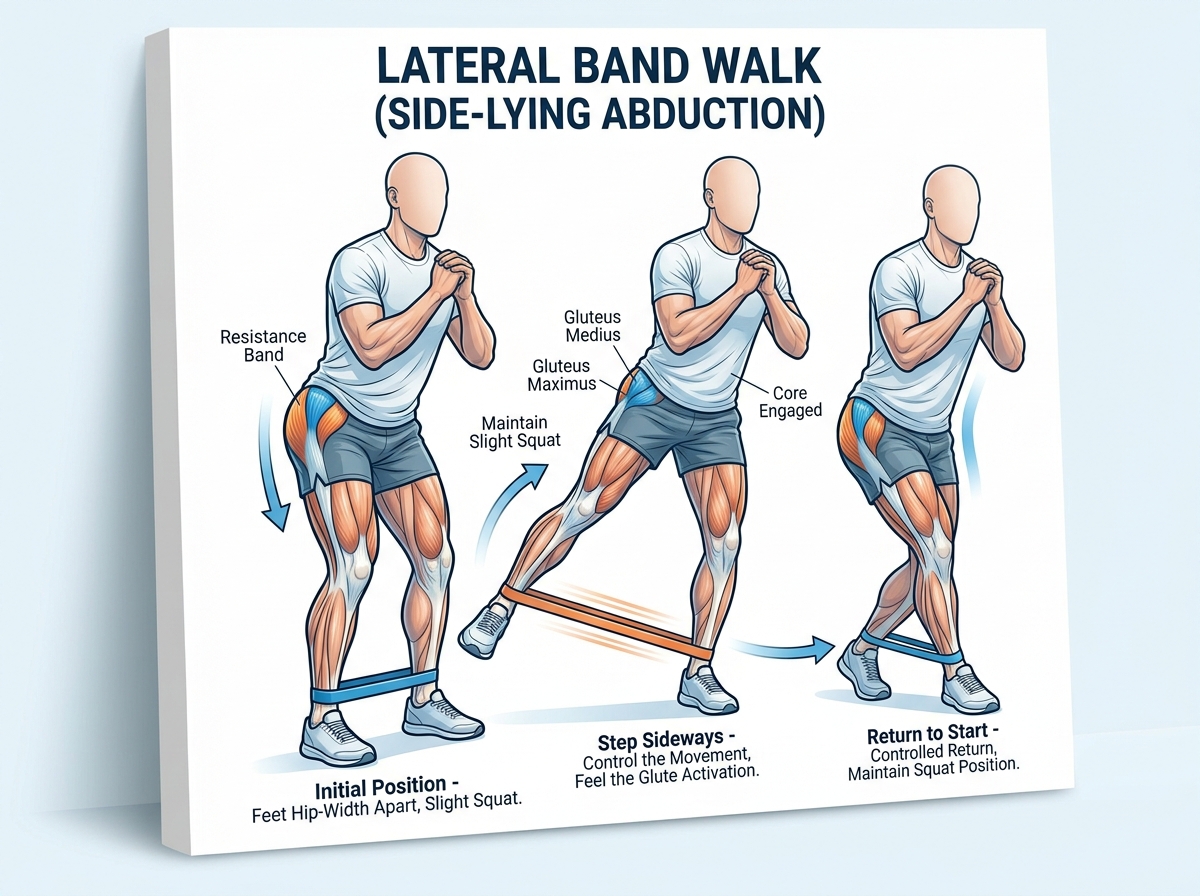
Lateral Band Walks — Gluteus Medius Strength

Lateral band walks for gluteus medius strength

Place a resistance band just above your ankles. Stand in a slight squat position, then step sideways while keeping tension on the band. Do not let your knees cave inward. Small, controlled steps.

  • Start with: 2 sets of 10 steps each direction
  • Progression: Lower band toward feet (harder)

Functional strength progression

Once you’ve activated your glutes with the exercises above, add these functional movements:

  • Single-leg squats and step-downs
  • Walking lunges with focus on hip extension at the top
  • Single-leg deadlifts (bodyweight to start)

Break up the sitting

Set a timer. Stand up every 45 minutes. Walk to the kitchen. Do five bodyweight squats at your desk. Your future running self will thank you.


The bottom line

Your glutes are the biggest muscle group in your body. When they go on strike, everything else suffers — your back, your knees, your times.

Whether you’re a desk worker training for your first half-marathon or a seasoned runner wondering why your hamstrings always feel tight, check in with your glutes. Are they actually working, or just along for the ride?

For more on building hip stability through targeted exercises, see Pilates and Hip Stability. If you’re dealing with lower back pain, waking up your glutes is often the first step.

Wake them up. Your running — and your back — depends on it.


16 Aug 2023 BY Katrina Tarrant POSTED IN Exercise, Physiotherapy, Pilates

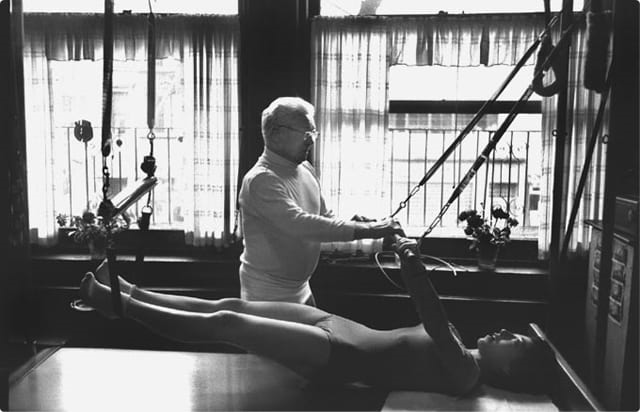
A brief history of Pilates

A brief history of Pilates

Pilates, an increasingly popular exercise regimen is known for its focus on strength, flexibility, and body awareness. You can find studios and gyms in almost all suburbs these days. But did you know that it has a rich history that traces back to the early 20th century?

The Pilates method was developed by Joseph Pilates, a German physical trainer, born in 1883. During World War I, he devised a system of exercises to help rehabilitate the bed-bound wounded soldiers, using springs attached to hospital beds to provide resistance. This laid the foundation for the equipment-based (reformer, barrel) Pilates exercises we see today.

Pilates believed in the inter-connectedness of physical and mental health, emphasizing the importance of proper breathing, alignment, and controlled movements. In the 1920s, he immigrated to the United States and opened a studio in New York City with his wife, Clara. The method gained popularity among the New York dancers and performers due to its ability to enhance strength and grace. It is known that the Pilates method of exercise builds elongated, yet strong muscles, unlike the shorter and strong muscles of lifting weights. Perfect for ballet and dance, where strength is required in very long levered movement of the body.

Pilates continued to refine his approach, developing a comprehensive system of exercises that targeted core muscles while promoting overall body balance. After his death in 1967, his disciples and followers continued to spread his teachings, evolving and adapting the method to suit modern fitness trends.

Today, Pilates is practiced worldwide, offering a holistic approach to physical fitness, rehabilitation, and stress reduction. Its longevity and enduring popularity stand as a testament to its effectiveness and the vision of its innovative creator.


14 Aug 2023 BY Katrina Tarrant POSTED IN Exercise, Physiotherapy

What are 'global muscles'?

And no, they are not well-travelled muscles!

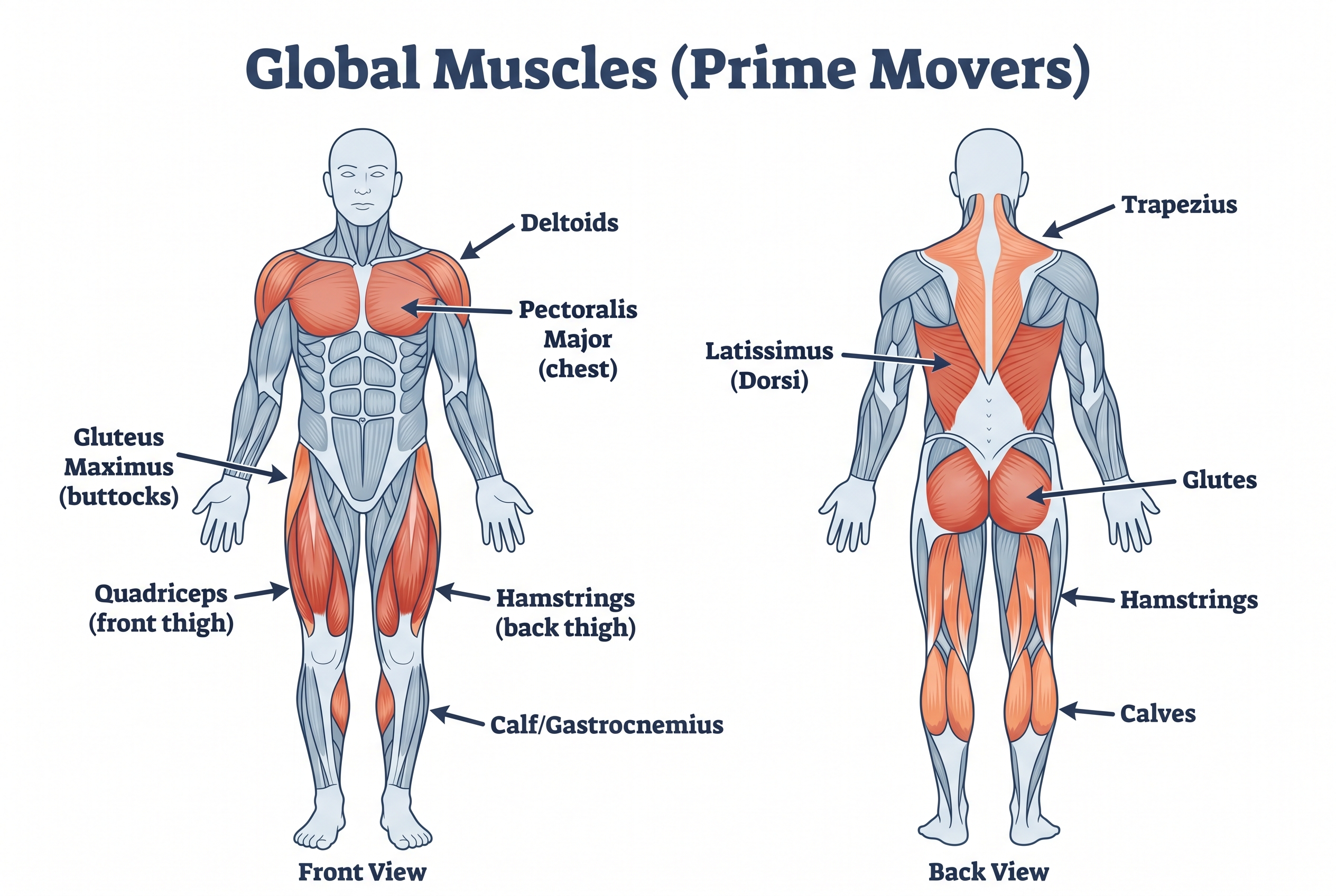
Global muscles, also known as prime movers or major muscles, are key muscles responsible for generating primary movements and providing the body with strength and power. These muscles are typically larger and situated closer to the body’s core. They work in coordination with the stabilising muscles ( they are all your deeper and postural ones- think deep abdominals, diaphragm, rotator cuff of the shoulder, deep gluteal layers of the hip, and the shoulder blade ‘pockets’) to facilitate various activities.

In the lower body, major global muscles include

  • the quadriceps (front of thighs)
  • the hamstrings (back of thighs)
  • gluteus maximus (buttocks)
  • the calf.

These muscles enable actions like walking, running, squatting, and jumping.

In the upper body, major global muscles contribute to pushing, pulling, and lifting movements, and can include:

  • the pectoralis major (chest)
  • deltoids (shoulders)
  • latissimus dorsi (back).

Global muscles diagram

Global muscles play a crucial role in performing everyday tasks and more intense physical activities. Engaging these muscles through exercise helps improve strength, endurance, and overall functional fitness. Proper training and conditioning of global muscles contribute to better posture, balance, and overall physical performance.

Image by Freepik


10 Aug 2023 BY Katrina Tarrant POSTED IN Exercise, Pilates

It's in: Lower your blood pressure with planks and wall sits!

A brand new research paper form the British Journal of Sports Medicine (fresh off the press in July 2023) rates the plank and the wall sit. I can hear you all groaning!

So, what does this paper have to say about these 2 exercises?

The research paper looked at how different types of exercise can help lower our blood pressure. Dissecting the results of 270 different trials where people did exercises, conclusions were drawn on what types of exercise lowered blood pressure. This is called anti-hypertensive exercise. In total, they looked at information from about 15,800 people, over several differing exercise such as running, weights, isometrics, and high intensity.

The results showed that all kinds of exercise can indeed lower blood pressure. For example, when people did aerobic exercises like jogging, both blood pressure numbers ( systolic and diastolic) went down. Lifting weights and high-intensity workouts were also effective at lowering blood pressure.

However, the researchers found that the exercise where you hold still, like the plank and wall sits, were the best at reducing blood pressure.These isometric-style exercises lowered both systolic and diastolic blood pressures greater than the other styles of exercise. 

There you go!

Reference: Edwards JJ, Deenmamode AHP, Griffiths M, Arnold O, Coooper N, Wiles, JD, O’Driscoll JM (2023). Exercise training and resting blood pressure: a large scale pairwise and network meta-analysis of randomised controlled trials. BMJ /BJSports 106503
Image by Freepik


Gluteus medius and pelvic stability

Controlling the pelvic ‘dump’

The gluteus medius is a crucial muscle located in the buttocks. It plays a significant role in stabilizing and controlling the movement of the pelvis and hips. The muscle is responsible for abduction of the hip joint, which is the movement of lifting the leg out to the side, away from the midline of the body. This action is particularly important during activities like walking, running, and maintaining balance.

More importantly, the gluteus medius prevents the opposite hip from dropping when the leg is lifted, ensuring the pelvis remains level during single-leg weight-bearing activities. This stabilization is vital for maintaining proper alignment and reducing the risk of injuries, such as those related to overuse or improper movement patterns. It is the primary controller preventing ‘dumping of the pelvis.’ The ‘dumped pelvis’, which we all know, creates a very unstable foundation for your trunk (spine) and hip joints.  

Weakness or dysfunction of the gluteus medius can lead to issues like hip pain, lower back pain, and altered gait patterns.

Strengthening the gluteus medius is best achieved through functional upright exercises, where your body weight ( and any additional weight you wish to add). These can include:

  • squatting and spit squatting
  • lunges
  • single leg balance and squat work, such as pistol squats
  • butt bands.

From a day to day perspective, you can also be looking after your pelvic foundation and hip health with good postures that ask your gluteus medius to always be at work. These can include:

  • standing without hanging on your hip
  • keeping your pelvis level across your hip bones with activities like stair climbing
  • controlling your hips and preventing that side to side swayed walking style (you can keep your modelling to the catwalk!) 

So look after your gluteus medius with these simple postural strategies and gluteus medius will look after you!


The nerve's protector

The nerve's protector

Meet the dura, and the reason we need to slide, glide and floss our nerves

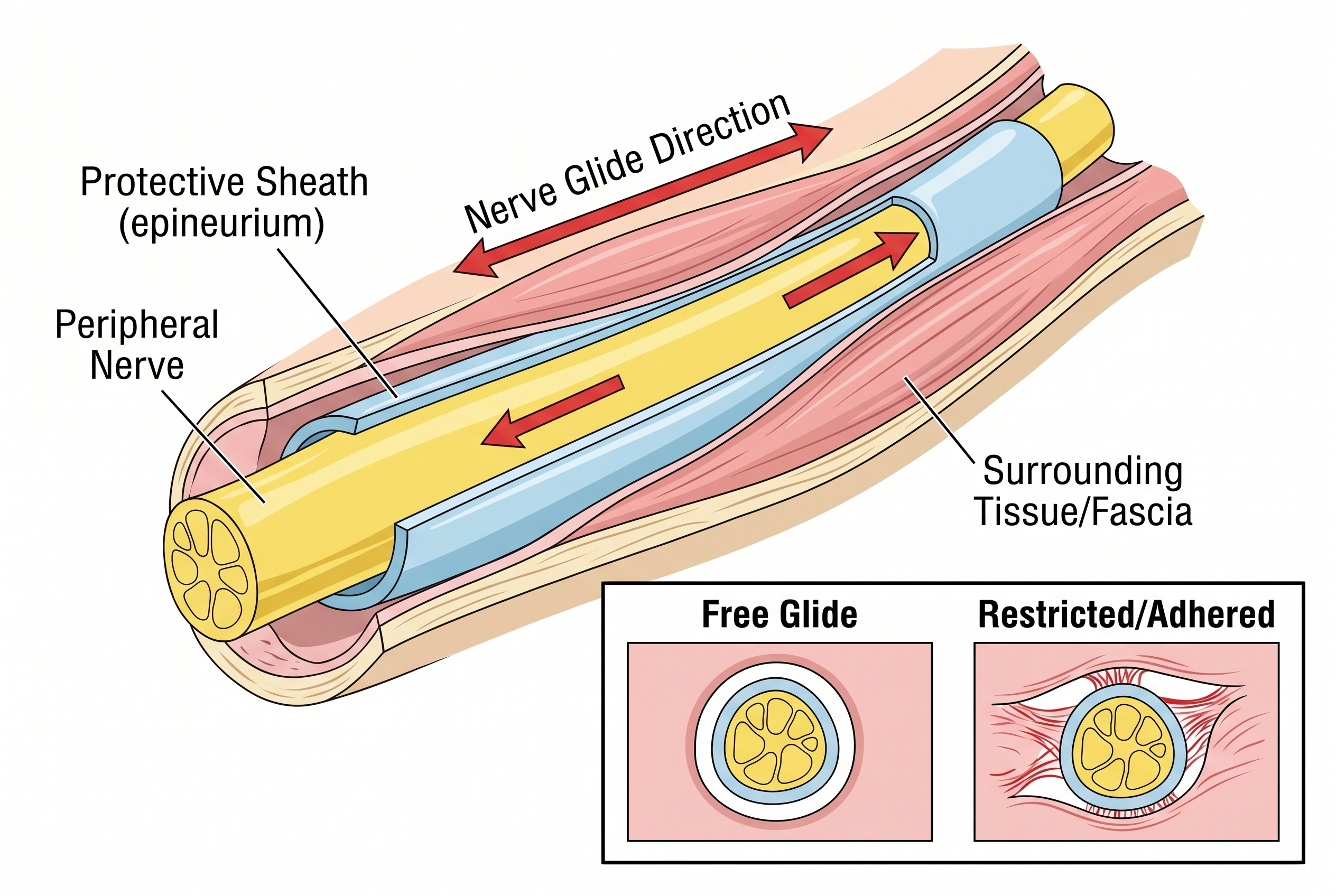
The dura mater is a tough and protective membrane that surrounds and supports the nerves in the body, particularly in the central nervous system, which includes the brain and spinal cord. Think of it like a strong and flexible “wrapper” that covers and shields the delicate nerves from potential harm. It helps to keep the nerves safe from injuries and impacts, providing an extra layer of defense. It also plays a role in maintaining the proper tension and position of the nerves within the body. Nerves need to move and stretch as our body moves. The dura mater helps to control and regulate this movement by providing a supportive structure. It’s a bit like a protective sleeve that allows the nerves to glide and shift without getting compressed or overly strained, ensuring that they can function properly even as we move and bend. This is important for preventing discomfort and maintaining the health of the nerves.

When things get stuck

The dura can sometimes become “stuck” or restricted due to various reasons. This condition is often referred to as dural tension or neural tension. Neural tension occurs when the dura and the nerves it surrounds experience limitations in their ability to move and stretch properly. This can lead to discomfort, pain, and even altered nerve function.

There are a few ways this can happen:

  • Physical Stress or Trauma: Injuries or traumas to the body, such as falls, accidents, or surgeries, can cause the dura mater to become stuck to surrounding tissues. This can restrict its normal movement and lead to neural tension.

  • Poor Posture: Maintaining poor posture for extended periods can cause the dura and nerves to be subjected to unnatural positions, potentially leading to restrictions and tension. Think here of slumped spinal postures, rounded tight shoulders or tucked bottoms. 

  • Muscle Imbalances: Imbalances in muscle strength or flexibility can cause the dura to become compressed or tethered, limiting its ability to glide smoothly and causing tension on the nerves. Piriformis Syndrome is a perfect example of this where deep buttock muscles compress and irritate the sciatic nerve. 

  • Inflammation or Scar Tissue: Inflammation or the formation of scar tissue around the dura and nerves can restrict their movement and lead to neural tension. This could occur after surgery. 

So when you are next told to ‘floss’ or ‘glide’ your nerves, you now know what structures you are actually targeting. A nerve and its protector ( the dura or sheath), like all other tissues in your body love movement. Remember, motion is the lotion!


23 Jul 2023 BY Katrina Tarrant POSTED IN Exercise, Physiotherapy, Pilates

Feldenkrais v Pilates: same same but different.

The Feldenkrais Method is a holistic approach to movement and body awareness that aims to improve physical functioning. Developed by Moshe Feldenkrais, an Israeli engineer and physicist, the method is grounded in principles of neuroscience, biomechanics, and psychology. It consists of two main components - Awareness Through Movement (ATM) and Functional Integration (FI).

Awareness Through Movement

ATM involves guided movement sequences designed to increase self-awareness, improve posture, and enhance flexibility. These sessions often take the form of verbally instructed group classes, where participants explore different movements to develop a deeper understanding of their own body mechanics.

In these classes, you might walk, stand, or sit in a chair, although usually, you will lie on the floor in a variety of comfortable positions. The teacher guides students through a sequence of movements, encouraging them to move with gentle attention within a comfortable range. Students can become more aware of unexpected and interesting connections within and between the movements, with often improving quality of movement, and the release of unnecessary muscular tensions throughout the body.

Functional Integration

FI, on the other hand, is a one-on-one approach where a Feldenkrais practitioner uses gentle touch and skilled manipulation to guide an individual’s movements. This personalized approach helps clients release tension, correct imbalances, and discover more efficient ways of moving.

Feldenkrais v Pilates

While both the Feldenkrais Method and Pilates are approaches that focus on improving movement and body awareness, they have distinct differences in terms of their principles, techniques, and goals.

The Feldenkrais Method emphasizes subtle and mindful exploration of movement. It encourages individuals to become more aware of their body sensations, habits, and limitations. The emphasis is on cultivating a deep understanding of one’s own body mechanics and finding more efficient ways of moving.

Pilates, on the other hand, is a structured exercise system focussing on building core strength, flexibility, and overall body conditioning through precise movements. Pilates exercises are often more dynamic and physically demanding than Feldenkrais movements. The primary goal of Pilates is to strengthen muscles, improve posture, and enhance physical fitness.

Photo by Bruce Mars on Unsplash


16 Jun 2023 BY Katrina Tarrant POSTED IN Exercise, Physiotherapy

Simple exercise: the 'sit to stand'

Grab a chair for 20 ‘sit to stands’ per day (and, the slower the better!)

The ‘sit to stand’ exercise, also known as the ‘squat to stand’, cannot be any easier. This simple and quick exercise offers several benefits for overall health and well-being. It is used by many falls prevention programs for the elderly to minimise the risk of falling and hospital admissions for broken hips, fractured wrists and head injuries.

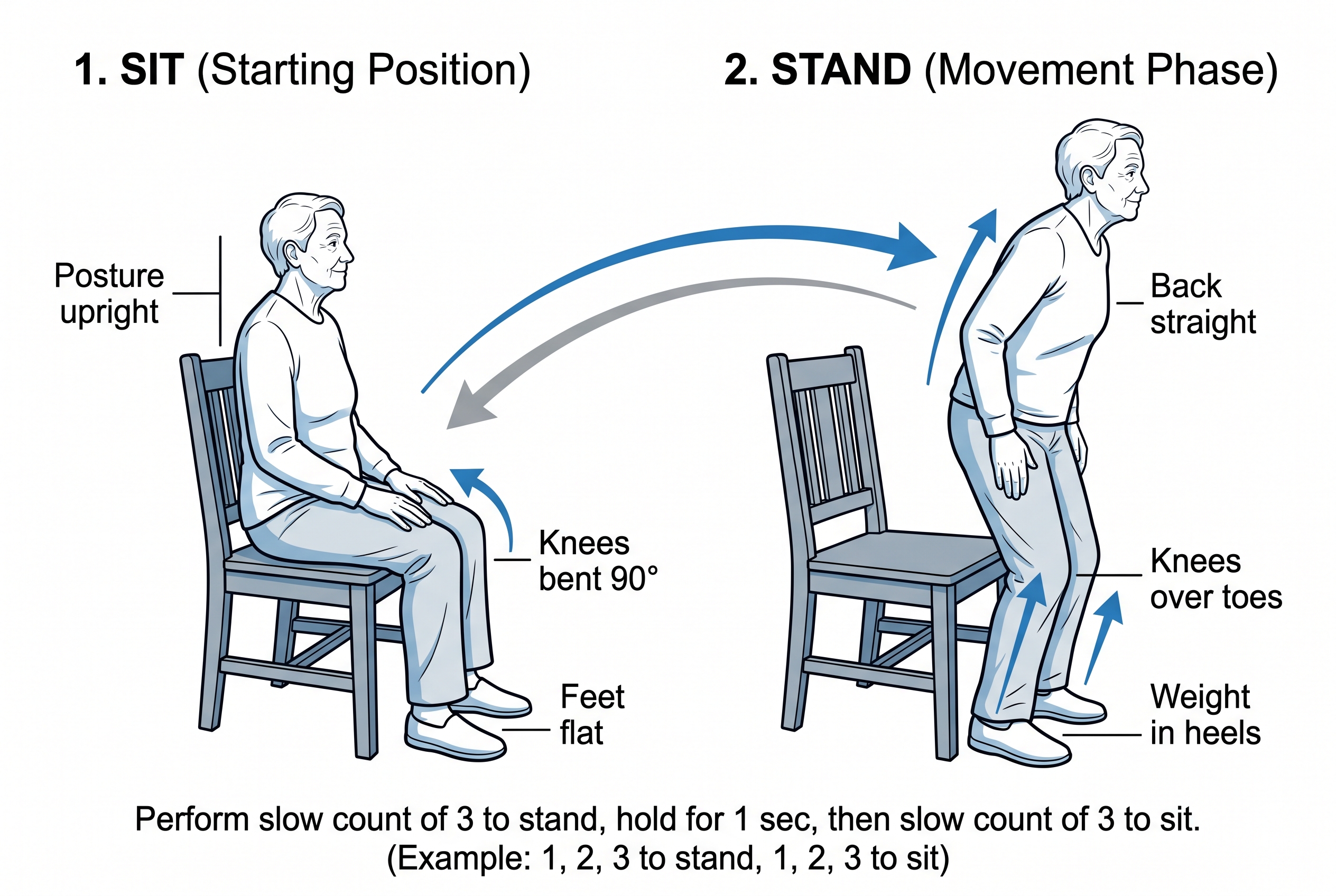
So, start today. Grab a sturdy chair (without arms is best) and place it up against the wall to stop any slippage. Starting in the seated position, stand slowly, taking a count of 3 to get up. Now return to your chair, but without dropping too fast ( taking the same count of 3 is suggested). Keep your weight balanced across your 2 legs, and keep your knees tracking straight ( knee caps running the line to your third toe). Feel the weight shift back into your hips and heels on the way down, and you should start to notice the work in your thigh and hip muscles as you repeat this move. Can you achieve 20 per day?

Sit to stand exercise diagram

Any pain? Please stop and see your physio.

The benefits

  • Strength, stability and power. The ‘sit to stand’ exercise primarily targets the muscles in your lower body, including the quadriceps, hamstrings, glutes, and calves. Regularly performing this exercise can help improve leg strength, stability, and power.

  • Enhances functional fitness. As a functional exercise, the ‘sit to stand’ movement mimics the action of standing up from a seated position, which is a common daily activity. By practicing this exercise, you improve your ability to perform this movement more efficiently, making it easier to carry out daily tasks such as getting out of a chair, getting up from the floor, or climbing stairs.

  • Promotes joint mobility. This exercise involves bending and extending the knees and hips, which helps improve joint mobility and flexibility. It can be particularly beneficial for maintaining or increasing range of motion in these areas.

  • Boosts core stability. While performing your ‘sit to stands’, your core muscles, including the abdominals and lower back muscles, are engaged to maintain stability and proper posture. This exercise can contribute to developing a strong and stable core.

  • Improves balance and coordination. This challenges your balance and coordination as you transition between sitting and standing positions. Consistent practice can enhance your proprioception (body awareness) and balance control, essential to prevent falls and speeding up your reflexes.

  • Supports bone health. Weight-bearing exercises like the ‘sit to stand’ exercise help promote bone density and strength. Regular participation in such exercises can potentially reduce the risk of osteoporosis and fractures.

  • Increases calorie expenditure. The ‘sit to stand’ exercise involves multiple large muscle groups, making it a compound movement that can increase calorie expenditure. Incorporating this exercise into your routine can contribute to weight management and overall calorie burn.

  • Suitable for various fitness levels. This is the perfect exercise to suit different fitness levels and abilities. Beginners can start with a higher seat or use assistance, such as holding onto a stable surface, while those with more strength and mobility can gradually progress to lower seats to perform the exercise without assistance.

  • Convenient and accessible. One of the advantages of this exercise is that it can be performed virtually anywhere with a chair or surface of appropriate height. It requires minimal equipment and can be easily incorporated into a home exercise routine or incorporated into daily activities.

 Photo by Jean-Philippe Delberghe on Unsplash


Fix News